A feeder that matches the press but mishandles thin strip, pilot release, or coil variation will create pitch errors, die damage, and lost production. By the end, you will be able to define the strip and press data, calculate the required feed performance, compare feeder designs, and request a quotation that reflects a complete working line.
Key takeaways
- Define strip width, thickness, pitch, coil weight, and layout before selecting a feeder.
- Calculate feed length, strokes per minute, accuracy, and pilot-release timing together.
- Choose roll, servo, air, gripper, or mechanical feeding based on material and control needs.
- Compare quotations for tooling, controls, safety integration, commissioning, spares, and local service.
Start with the Strip and the Complete Fin-Line Layout
A feeder suits a fin processing machine only when its strip-handling range and position in the complete line are defined together. Press tonnage alone cannot prove compatibility: a feeder can handle the press load yet damage thin fin stock, miss the pitch, or fail during pilot release.
Record these strip and coil inputs before requesting a quotation:
- Alloy, temper, tensile strength, surface finish, minimum and maximum thickness, and strip width
- Coil outside diameter, inside diameter, maximum mass, and required uncoiler capacity
- Feed pitch, feed length per stroke, number of parts or rows per stroke, and required feed accuracy
- Press strokes per minute, target production rate, and the maximum strip loop allowed
- Minimum thickness and width-to-thickness ratio, because thin material can buckle even when the feeder’s maximum-thickness rating looks adequate
Map the feeder into the complete line, not as a stand-alone box:
- Coil loading and decoiling before the straightener or straightener-feeder
- Strip entry height, die entry height, press-bed height, feed direction, and available space
- Pilot-release timing, threading access, guarding, and transfer to scrap or part handling
- Press-ready, feeder-ready, overload, emergency-stop, and fault signals exchanged through the line controls
Confirm that the feeder, straightener, drive, and coil line can accelerate and decelerate the strip. A 300 mm feed at 60 strokes per minute requires 18 m/min of strip travel; average speed alone is not enough.
Calculate Feed Length, Speed, Accuracy, and Press Timing
A 50 mm fin pitch at 120 press strokes per minute requires 6,000 mm/min of average strip travel. Calculate the feeder from the actual advance per stroke, not from press speed alone: feed rate equals feed length multiplied by strokes per minute.
If the die produces two rows per stroke, confirm whether the 50 mm figure is the strip advance or only the row spacing.
- Record the feed length per stroke, press speed, parts or rows produced per stroke, and the maximum permitted strip-loop length.
- Calculate required rate: feed length in millimetres × strokes per minute. Add production capacity only after confirming the die’s actual pitch and layout.
- Measure the feed window from the press signal to the next forming event. The feeder must finish its move, settle, and receive pilot release inside that window; average speed equals feed length divided by available feed time.
- Specify acceleration and deceleration performance at the required pitch. A feeder rated for 120 strokes per minute unloaded may not reach 120 with a long index, thin aluminium, or a short feed window.
Set accuracy as feed-length repeatability at the actual strip width, thickness, alloy, feed length, and production speed. Ask for a test using your die and pilot-release sequence, then inspect strip camber, coil set, roll slip, clamping force, contamination, and acceleration marks.
Approve the specification only after a sustained run records strokes per minute, repeatability, scrap, misfeed recovery, and press-stop response. Include recipe-controlled pitch and speed so operators cannot restore production with an unverified setting.
Choose Between Roll, Servo, Air, Gripper, and Mechanical Feeders
Thin aluminium fin stock usually favors a servo roll feeder with independently adjustable roll pressure. Set pressure high enough to prevent slip, but not so high that the rolls mark or buckle the strip during pilot release. Specify the roll surface, pressure range, and setup method for each material thickness.
| Feeder design | Best fit | Main limitation |
|---|---|---|
| Servo roll | High-speed indexing, multiple pitches, variable part lengths, skip feeds, and frequent changeovers | Higher cost and greater controls-integration effort |
| Mechanical | One established pitch on a simple single-pitch line | Changing pitch normally requires crank, cam, or linkage adjustment |
| Air | Short or moderate feed lengths where low purchase cost and straightforward pneumatic control matter | Air compression and flow variation can reduce repeatability at high speed |
| Gripper | Long feed lengths, delicate strip, or applications where roll contact could mark aluminium | Requires die-side space and can reduce cycle speed |
| Fixed roll | Stable, repetitive feeding of strip with limited recipe variation | Limited flexibility if pitch or product dimensions change |
Choose a servo roll feeder for rapid indexing only after checking actual strip travel. A 300 mm feed at 60 strokes per minute requires 18 m/min of strip movement, plus acceleration and deceleration capacity. The drive, rolls, straightener, and uncoiler must handle that motion without slip or loop instability.
Use an air or gripper feeder when the strip is too delicate for reliable roll traction, then confirm pilot-release behavior and achievable pitch accuracy with production material. Choose mechanical feeding when one pitch will remain fixed and low changeover cost matters more than recipe flexibility.
Match the Feeder to the Die, Controls, and Safety System
Approve the feeder only after it completes the selected die’s feed window, not merely its advertised strokes-per-minute rate. Confirm the press supplies a timed feed signal and enough dwell for acceleration, feed, pilot release, and settling before the next forming event.
1. Check the mechanical fit: press-bed height, die entry height, shut height, die width, feed direction, strip centreline, available space, and maximum loop height. Verify the uncoiler, straightener, feeder, and scrap equipment handle the same coil width and maximum coil mass.
2. Check pilot release: the die must release the strip before feeding begins, with a confirmed release signal and adjustable release timing. A missed release can stretch the strip, damage pilots, or shift fin pitch.
3. Check electrical compatibility: match voltage, control architecture, encoder feedback, I/O, communication protocol, and press-ready, feeder-ready, overload, emergency-stop, and fault signals. Require recipe-controlled feed length and speed, alarm history, and stroke or part counts.
4. Define fault responses for misfeed, double-hit, strip-end, press overload, encoder loss, and die-protection trips. Each condition needs a controlled press stop, fault indication, restart permission, and a recovery procedure that prevents a second hit.
5. Verify guarding, interlocked access doors, emergency stops, stored-energy isolation, and safety-rated servo shutdown. Test every circuit with the die installed.
For an automotive press feeder, run acceptance trials using production strip and the production die. Record sustained strokes per minute, feed repeatability, scrap rate, coil-end handling, changeover time, and every press-stop and die-protection interlock. Dry cycling alone is not approval evidence.
Build a Comparable Quotation and Validate Local Support
Submit a line-ready data sheet, not a tonnage figure. Include:
- Alloy and temper, strip width and thickness range, coil mass, outside and inside diameters
- Feed pitch, rows or parts per stroke, strokes per minute, accuracy target, and required production rate
- Press-bed and die-entry heights, feed direction, available loop height, die width, and press-control signals
- Coil loading method, scrap removal, changeover frequency, and whether the quotation must include installation and commissioning
Require separate prices for the items that alter industrial press feeder price. A low base-machine quote is not comparable with a production-ready line.
| Item | Price variable | What to compare |
|---|---|---|
| Base feeder | Servo capacity, feed length, width and thickness range | Rated performance on your strip |
| Line equipment | Uncoiler, straightener, brake, threading gear and loop control | Coil limits and threading time |
| Integration | PLC/HMI changes, die sensors, guarding and interlocks | Press-ready, overload and emergency-stop signals |
| Delivery | Spare rolls, installation, training and commissioning | Included scope and acceptance criteria |
| Validation | Product recipes and production testing | Results using your strip and die |
For a fin press feeder in Chennai or a press feeder in Chennai, ask for commissioning response time, stocked servo drives and sensors, electrical-standard compatibility, remote diagnostics, and technicians who understand your press and die.
Ask Hydropower Engineers to identify who will test loop control, press-stop signals, die protection, feed repeatability, coil-end handling, and fault recovery. Approve the supplier only after a sustained production trial records strokes per minute, scrap rate, changeover time, and interlock operation.
Related products
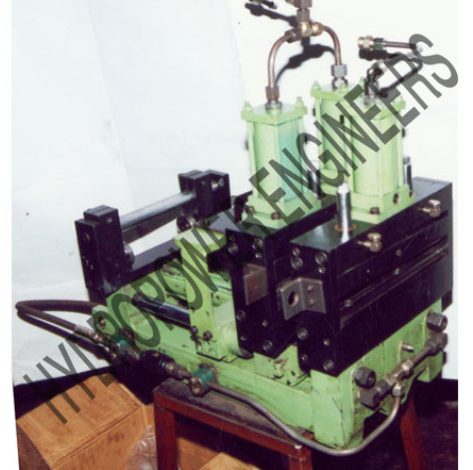 | Special Equipments from Hydropower Engineering Systems are precision-engineered systems designed for synchronized and accurate feeding of continuous metal strips into... View product → |
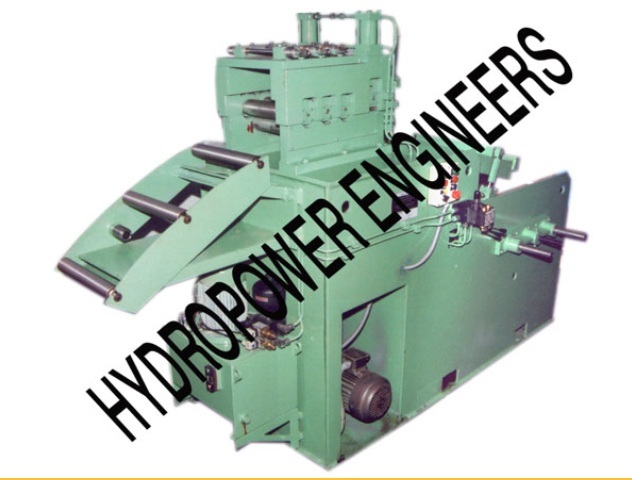 | Decoiling cum Staraightening Machine Decoiling cum Staraightening Machine De-coiling machines are essential press-feeding equipment used to handle sheet metal in the form of large coils from rolling mills. View product → |
Frequently asked questions
What should you define before choosing a fin press feeder?
Document strip width, thickness, material, coil weight, feed pitch, line layout, press dimensions, and the positions of the decoiler, straightener, feeder, die, and scrap system.
How do you calculate feeder capacity for a fin processing line?
Set the required feed length per stroke, press strokes per minute, strip accuracy, acceleration, and timing for pilot release. Check that the feeder reaches the pitch before the next press cycle.
Which feeder type suits a fin processing machine?
Roll, servo, air, gripper, and mechanical feeders suit different strip conditions and production needs. Compare their control range, accuracy, speed, material handling, maintenance, and integration requirements.
What should a comparable feeder quotation include?
Request the feeder range, rated speed, stated accuracy, press and die interfaces, controls, safety circuits, installation, commissioning, training, spare parts, warranty terms, and local service coverage.