A C-frame press and a squeeze bending machine apply force in different ways, so a machine selected by tonnage alone can produce poor bends, damaged tubes or inaccurate parts. By comparing the forming process, workpiece geometry, tooling, force calculation and frame limits, you can prepare a quotation that matches the job rather than the machine’s marketing label.
Key takeaways
- Choose a C-frame press for die-based forming and general pressing.
- Choose squeeze bending for controlled tube and profile forming.
- Size force and throat depth from the actual part and tooling.
- Compare safeguards, tooling, deflection limits and service before buying.
Choose the machine by process, not by the word “press”
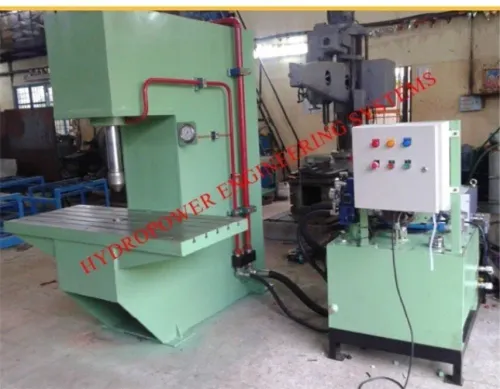
A C-frame press and a squeeze bending machine are different machine types, processes and applications. The search phrase c frame press or squeeze bending machine in Chennai joins a general-purpose open-frame hydraulic press with a tube-forming machine. A press supplies force through a ram; its result depends on the die.
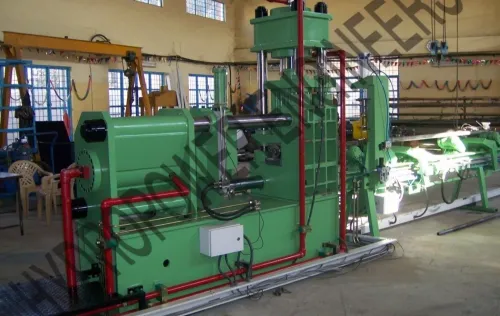
Squeeze bending forms a tube around a die by pushing it against a supported radius.
| Machine | Process | Typical application |
|---|---|---|
| C-frame press | Ram drives a punch into a die or fixture | Blanking, punching, pressing, assembly and formed sheet or plate parts |
| Squeeze bending machine | Pressure die pushes a supported tube around a form die | Tube and profile bends where simpler tooling suits the required radius |
| Press brake | A long punch and die create a controlled linear bend | Sheet, plate, channels and repeated angle bends |
| Rotary-draw bender | A clamp and rotating bend die pull tube around a radius | Accurate tube bends with tighter control of ovality and wall thinning |
During squeeze bending, the form die supports the tube while the pressure die applies the bending force. The outside wall stretches, the inside wall compresses and the tube springs back after unloading, leaving a different angle or radius from the tool setting. Expect more ovality and less wall-thickness control than rotary draw.
Specify these as separate metal forming equipment requirements. For the press, state force, stroke, daylight, bed size, die space and eccentric-load rating. For the bender, state tube outside diameter, wall thickness, grade, centre-line radius, angle, ovality limit and tooling.
Match the machine to the workpiece and the bend you need
A flat bracket, short plate flange, channel, or formed assembly suits a C-frame press when the tooling can reach the work and the load stays close to the ram’s centreline. It presses a part between a punch and die; it does not automatically produce a controlled bend along a long, continuous radius.
| C-frame press | Flat sheet, plate, brackets, channels and local forming | Punching, flattening, coining, short flanges and repair work with guided tooling |
|---|---|---|
| Squeeze bending machine | Round or shaped tubes and some profiles | Moderate-radius bends where simpler tooling and lower setup effort matter more than tight control of ovality |
| Dedicated press brake | Long sheet or plate parts with straight bend lines | Repeated flanges, boxes and panels requiring controlled angle, bend length and repeatability |
| Rotary-draw bender | Thin-wall tube, tight-radius tube and appearance-critical work | Use a mandrel, wiper die and pressure die when section integrity and dimensional control matter |
A squeeze bending machine in Chennai should be matched to tube outside diameter, wall thickness, material grade, bend angle and centre-line radius—not maximum diameter alone.
The tube rests against a form die while a pressure die pushes it around that form; springback then opens the angle, while excessive compression can wrinkle the inside or flatten the section.
Choose a C-frame press only after checking throat depth, daylight, bed size and permissible eccentric-load rating. A part that loads one side of the frame can exceed its moment limit even when the tonnage appears sufficient. For tight tube radii, thin walls or visible surfaces, specify rotary-draw tooling instead of accepting squeeze bending by default.
Specify force, dimensions and tooling from the actual part
A usable quotation starts with the actual part, not a nominal tonnage. A search for c frame hydraulic press in chennai can return an open-frame forming press and a tube-bending machine, so issue separate requirement sheets for each process.
- Material: state the grade, yield strength and condition. Stainless steel, high-strength steel and mild steel require different forming loads and springback allowances.
- Thickness and length: give sheet thickness or tube wall, plus the contact length being formed. Force rises with both.
- Bend: specify angle, centre-line radius and inside radius. A tight radius needs different punch and die geometry from a broad sweep.
- Tooling: provide punch nose radius, die opening or tube-forming tooling, clearance, blank support and stripper requirements. High tonnage cannot compensate for a die that lets the part slide or buckle.
- Machine envelope: state throat depth, bed dimensions, daylight, stroke, off-centre-load rating and finished-part clearance. Adequate force is useless if the die cannot reach the work or the frame cannot carry the eccentric load.
Require a documented calculation or sample bend using your material and tools. Cylinder force begins with F = p × A, but usable force is lower after seal friction, hydraulic losses, linkage geometry and tooling demand.
For tube work, specify outside diameter, wall thickness, grade, bend angle, centre-line radius and allowable ovality; maximum tube diameter alone hides whether the machine can form thin-wall stainless or thick-wall steel.
Account for throat depth, deflection and tube-bend quality
A press with enough tonnage can still miss the part if its die cannot reach through the throat or the frame deflects under load. In a C-frame press, check:
- throat depth
- daylight
- bed dimensions
- off-centre-load rating
The open throat gives useful three-sided access, but less torsional rigidity than a four-column or H-frame design. An off-centre die load can change die clearance across the bed, producing angular variation and accelerated guide or tooling wear.
The error repeats only when load position and tooling setup repeat; move the part and the result can change. Deflection also alters the final angle, so springback compensation from a centred trial may not hold at the working position.
Squeeze bending supports the tube against a form die and pushes it around the radius with a pressure die. It is simpler than rotary draw, but it provides less control over material flow. The following conditions can damage section quality:
- a tight bend radius
- a thin wall
- poor lubrication
- incorrect pressure-die setting
These conditions produce inside wrinkles, flattening and excess ovality. Springback then changes the released bend angle and radius, making repeatability depend on material grade, wall thickness, lubrication and die settings.
Specify the outside diameter, wall thickness, material grade, bend angle, centre-line radius, ovality limit and wall-thinning limit. Choose a mandrel, wiper die or rotary-draw process when appearance, section integrity or tight-radius accuracy matters more than simple tooling.
Issue a comparable quotation and verify safeguards
Ask every supplier to quote against the same two requirement sheets; “press” and “bending machine” are not comparable specifications. Give Hydropower Engineers the same sheets you give any hydraulic press manufacturer, including the acceptance tests and safety documents.
| Machine | Put in the quotation request | Verify before selection |
|---|---|---|
| C-frame press | Force, stroke, daylight, bed size, throat depth, die space, working pressure, flow, pressing speed, return speed, dwell and permissible eccentric load | Confirm force at the required speed, guided-platen design and stated moment rating |
| Squeeze bending machine | Tube outside diameter, wall thickness, material grade, bend angle, centre-line radius, tooling, cycle time and allowable ovality | Run your tube and record radius, springback, ovality and section damage |
For a C-frame hydraulic press in Chennai, reject a quote that gives only tonnage. Maximum pressure is a limit, not proof that the pump sustains that pressure throughout the stroke. For a squeeze bending machine in Chennai, maximum tube diameter alone hides the difference between thin-wall stainless steel and thick-wall mild steel.
- Request the hydraulic schematic and separate figures for maximum pressure, working pressure, pump displacement or flow, motor power and dwell.
- Request the ISO 16092-3 conformity basis, risk assessment, guard layout, two-hand or guarded control behaviour, emergency-stop response and validation records.
- Ask how the supplier will prove repeatability using your material, tooling and production cycle; require written limits for springback, ovality and force.
Related product
 | Hydraulic Presses We are a leading and well-recognized manufacturer of C-Frame Hydraulic Presses, widely used in applications such as embossing, punching, piercing,... View product → |
Frequently asked questions
What is the difference between a C-frame press and a squeeze bending machine?
A C-frame press drives a ram into a die for pressing, punching or forming. A squeeze bending machine applies controlled force through tube-bending tooling to shape tubes or profiles.
How do you choose between a C-frame hydraulic press and a squeeze bending machine?
Choose by the required process. Select a C-frame hydraulic press for general die-based work; select a squeeze bending machine when tube-bend geometry, repeatability and tube quality control the job.
What machine specifications should you provide for a quotation?
Provide material grade, tube or part dimensions, wall thickness, bend radius, bend angle, production volume, required force, throat depth, stroke, daylight and tooling details.
Why do throat depth and deflection matter on a C-frame press?
Throat depth determines how far the work can sit from the frame, while frame and bed deflection affect accuracy under load. Check both against the actual die and part dimensions.
What should you verify before buying metal forming equipment?
Request a quotation with matching specifications, tooling, commissioning and service details. Verify guarding, two-hand controls or light curtains, emergency stops and safe hydraulic operation.