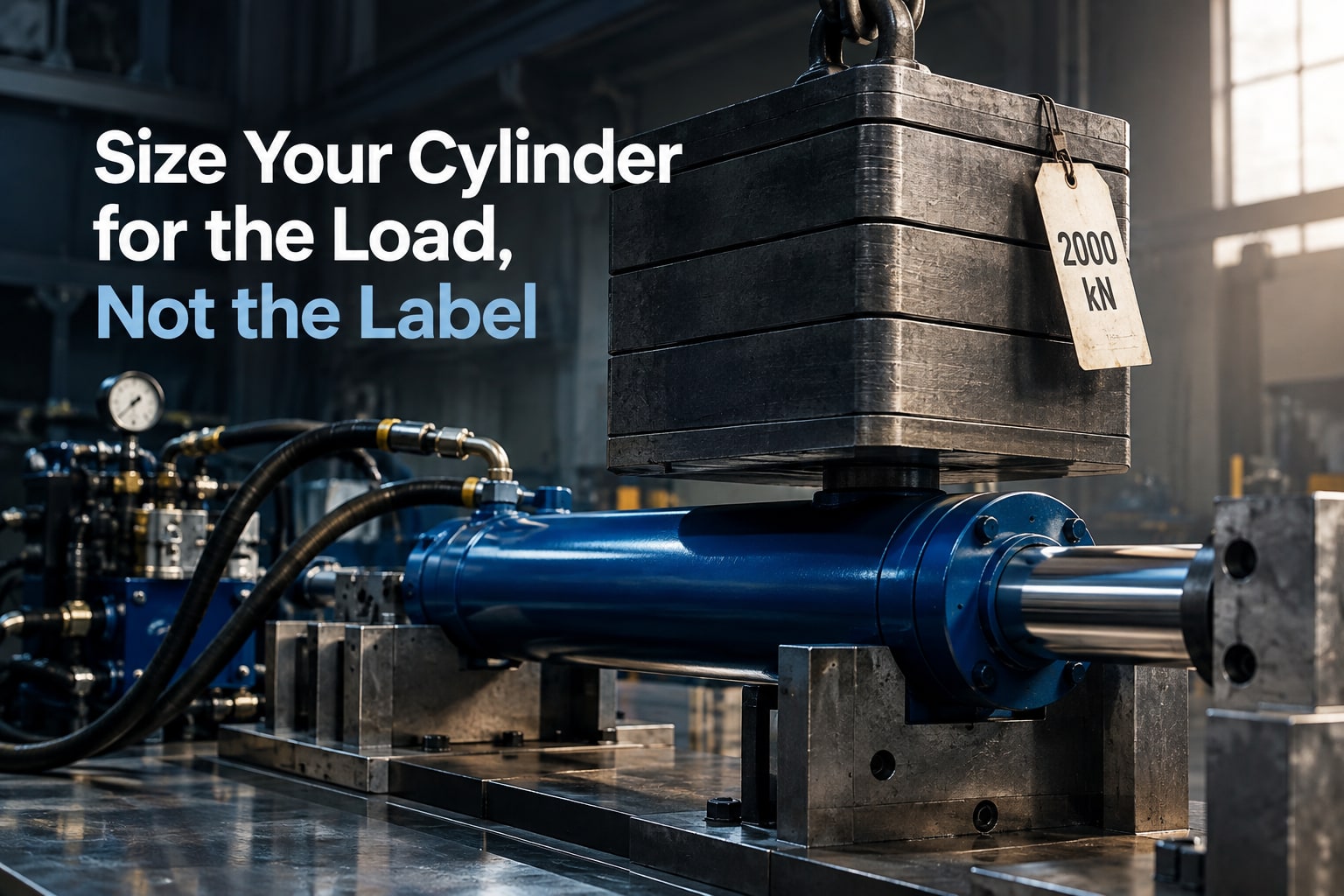
A cylinder’s tonnage label does not tell you whether it will lift, press, or retract safely in your machine. You will be able to calculate the required force, size the bore and rod, check mounting and buckling risks, and prepare a supplier specification that addresses pressure, speed, service life, and testing.
Key takeaways
- Calculate peak cylinder force from load, leverage, friction, and acceleration.
- Size bore, rod, stroke, and mounting envelope as one system.
- Specify pressure, speed, cushioning, alignment, seals, and cleanliness limits.
- Require calculation sheets, test records, and documented acceptance criteria from suppliers.
Convert the machine load into usable cylinder force
Calculate from the peak force at the cylinder, not from the machine’s load label or a catalogue tonnage rating. For a lifting or pressing cycle, establish the worst-case demand:
- Weight: mass × 9.81 m/s²
- Acceleration or deceleration force: mass × acceleration
- Guide and seal friction
- Tooling, forming, or material resistance
- Impact, pressure-transient, and emergency-stop effects
Add these forces, then multiply the result by a documented safety factor suited to the impact and duty cycle. The cylinder’s usable force must exceed that design demand.
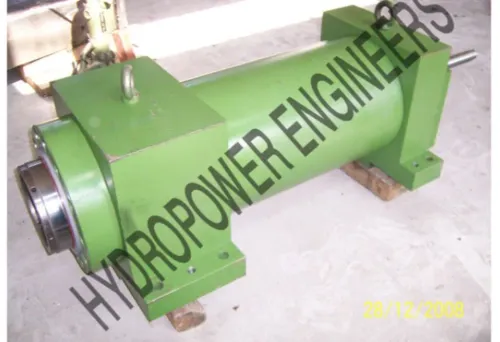
Choosing a high tonnage hydraulic cylinder for heavy duty applications also requires separating extension force from retraction force. Use F = p × πD²/4 for extension and F = p × π(D² − d²)/4 for retraction, where p is working pressure, D is bore diameter, and d is rod diameter.
Subtract seal friction and hydraulic losses before comparing either result with the requirement.
For example, a 100 mm bore at 700 bar working pressure produces about 550 kN, or 56 metric-tonne-force, before losses. A 50 mm rod reduces the effective return area, so retraction force is about 412 kN, or 42 metric-tonne-force.
Use the actual regulated working pressure, not the pump’s maximum rating; designing at the maximum leaves no allowance for pressure variation or overload control. A static calculation alone does not prove resistance to buckling, fatigue, or impact.
Size the bore, rod, stroke, and mounting envelope together
A bore that delivers the required force can still fail if the rod buckles or the mount introduces side load. For large hydraulic cylinder selection, size the piston area from working pressure, then check rod diameter against peak compressive force, unsupported length, material properties, and effective-end condition.
A long, pin-ended rod has far less buckling capacity than a short, guided rod; increasing bore alone does not solve that problem.
Give the supplier one dimensional envelope, not only tonnage and stroke:
- Bore and rod diameter, calculated at working and peak pressure
- Stroke, retracted length, extended length, mounting height, and available clearance
- Pin, flange, trunnion, or clevis geometry, including pin shear and bearing limits
- Unsupported rod length at every position and any external guide or load-support system
- Allowable side load, angular movement, and thermal or structural movement
| Mounting choice | Load-path strength | Use it when |
|---|---|---|
| Flange | Direct axial thrust; resists a rigid straight-line load | The cylinder and machine faces remain aligned |
| Clevis with pin | Allows pivoting but concentrates pin shear and bearing stress | The attachment angle changes through the stroke |
| Trunnion or spherical mount | Accommodates rotation and alignment variation | Structural movement could otherwise bend the rod |
Choose stroke from the required machine travel, then add mechanical clearance without creating excessive free rod length. Verify the retracted envelope against guards, tooling, hoses, and access for seal replacement. A mount that fits the drawing but cannot tolerate alignment error will turn useful force into friction, wear, and rod damage.
Set pressure, speed, cushioning, and alignment limits
A safe cylinder is selected against the entire working cycle, not a static tonnage target. Set operating pressure below the cylinder’s design limit, account for peak transients, and leave margin below the pump’s maximum pressure. Repeated pressure changes and impact loads can shorten fatigue life even when each load stays below the nominal rating.
Give the supplier a cycle definition, not only force and stroke:
- Operating and peak pressure, flow rate, extension and retraction speed
- Moving mass, acceleration, stopping distance, and expected impact loading
- Pressure range, cycles per hour, total design cycles, and duty cycle
- Fluid, temperature, side-load conditions, mounting geometry, and available alignment clearance
Speed follows flow divided by effective piston area, so a larger bore can slow motion at the same pump flow. Check both directions because the rod reduces retraction area.
Choose cushioning from the moving mass and velocity at end of stroke. An undersized cushion causes impact and pressure spikes; an overly restrictive cushion creates heat and makes final travel sluggish. Use an adjustable cushion, external deceleration valve, or proportional control when the tool reaches the end rapidly.
Keep the rod axis aligned with the load through the full stroke. Guides, clevises, trunnions, or spherical mounts must prevent bending loads from entering the rod.
A heavy duty cylinder buying guide should also require stroke and cushion checks, pressure-test records, and dimensional inspection; a shop pressure test does not prove alignment, buckling resistance, or fatigue life.
Specify materials, seals, cleanliness, and service life
A cylinder that passes one pressure test can still fail early from fatigue, contamination, corrosion, or rod buckling. Specify the load spectrum, not only the maximum tonnage: expected cycles, pressure range, stroke frequency, duty cycle, impact loads, and required service life.
Threads, ports, welded ends, and mounting attachments deserve fatigue review because stress concentrations can govern life below the nominal rating.
Match materials and surface treatments to the fluid and environment. State the tube and rod material, rod hardness or chrome finish, corrosion protection, and temperature range. Select seals for the hydraulic fluid, pressure, temperature, extrusion gap, and contamination level; an incompatible seal can swell, harden, leak, or shed particles onto the rod.
Put these requirements in the purchase specification:
- Identify the hydraulic fluid, operating and peak temperature, pressure range, expected cycles, and impact conditions.
- State the ISO 4406 cleanliness target, filter rating with beta ratio, flushing procedure, and oil-sampling method.
- Define protection against water, dust, abrasive scale, chemicals, and outdoor corrosion.
- Require seal identification, rod surface treatment, material certificates, and heat-treatment records where specified.
Demand acceptance records that match the duty:
- Dimensional inspection for bore, rod, stroke, mounting points, and retracted length.
- Pressure or proof-test results with test pressure and hold time.
- Leakage results, stroke verification, and cushion-function checks.
- Traceable cylinder and seal identification.
A shop pressure test confirms containment; it does not prove fatigue life, buckling resistance, cleanliness, or correct machine alignment.
Compare suppliers using calculations and acceptance records
Give every bidder a design dossier, not just “required tonnage and stroke.” Include bore and rod diameters, stroke, retracted and extended lengths, mounting geometry, extension and retraction forces, operating and peak pressure, flow, speed, duty cycle, fluid, temperature, side loads, and environmental exposure.
- Require a signed calculation using peak load, pressure transients, friction, acceleration or stopping forces, and the safety factor. Check extension force with F = p × πD²/4 and retraction force with F = p × π(D² − d²)/4; catalogue tonnage alone does not prove suitability.
- Ask for the applicable ISO or customer dimensional standard, seal and rod specifications, replacement-seal lead time, installation instructions, and repair arrangements.
- Define acceptance before placing the order: dimensional inspection, material or heat-treatment certificates where specified, proof-pressure and leakage results, stroke and cushion checks, and serial-number traceability.
- Specify hydraulic cleanliness as an ISO 4406 particle-count code, plus filter rating, beta ratio, flushing procedure, and sampling method.
| Supplier evidence | What it proves | What it does not prove |
|---|---|---|
| Local assembly or distribution | Sourcing and delivery capability | Design, fatigue, buckling, or repair capability |
| Engineering manufacturer | Signed calculations and design review | Correct installation without site verification |
| Test-record supplier | Pressure, leakage, dimensions, and cushion performance | Long-term fatigue life or resistance to side load |
A high tonnage hydraulic cylinder supplier in Chennai should show who performed the calculation and test, not merely provide a stamped catalogue sheet. Ask Hydropower Engineers and competing bidders for the same records when comparing an industrial hydraulic cylinder in Chennai. A pressure-test pass does not establish buckling resistance or machine alignment.
Related product
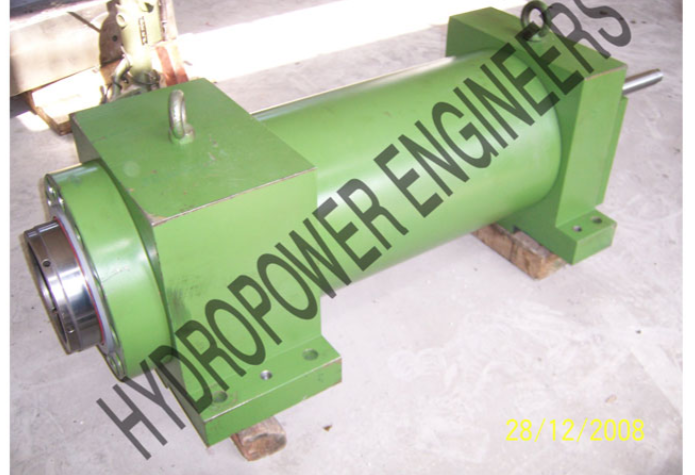 | Hydraulic Cylinders Hydropower Engineering Systems offers robust and high-performance High Tonnage Hydraulic Cylinders designed to deliver exceptional linear force for... View product → |
Frequently asked questions
How do you calculate the force required from a high-tonnage hydraulic cylinder?
Start with the peak force at the cylinder, then account for machine leverage, friction, acceleration, and the worst-case lifting or pressing condition. Convert the resulting demand into cylinder force at the selected working pressure.
How should you size the bore, rod, and stroke?
Select bore area for the required extending force, then check the rod area for retracting force. Verify rod buckling, stroke length, retracted length, mounting envelope, and side-load exposure together.
Which operating limits should you specify?
Define maximum working pressure, cycle speed, oil temperature, cushioning requirements, alignment limits, and allowable side load before requesting quotations.
What should you ask a high-tonnage hydraulic cylinder supplier to document?
Request design calculations, material and seal specifications, cleanliness requirements, pressure-test results, dimensional inspection records, and acceptance criteria tied to the finished cylinder.