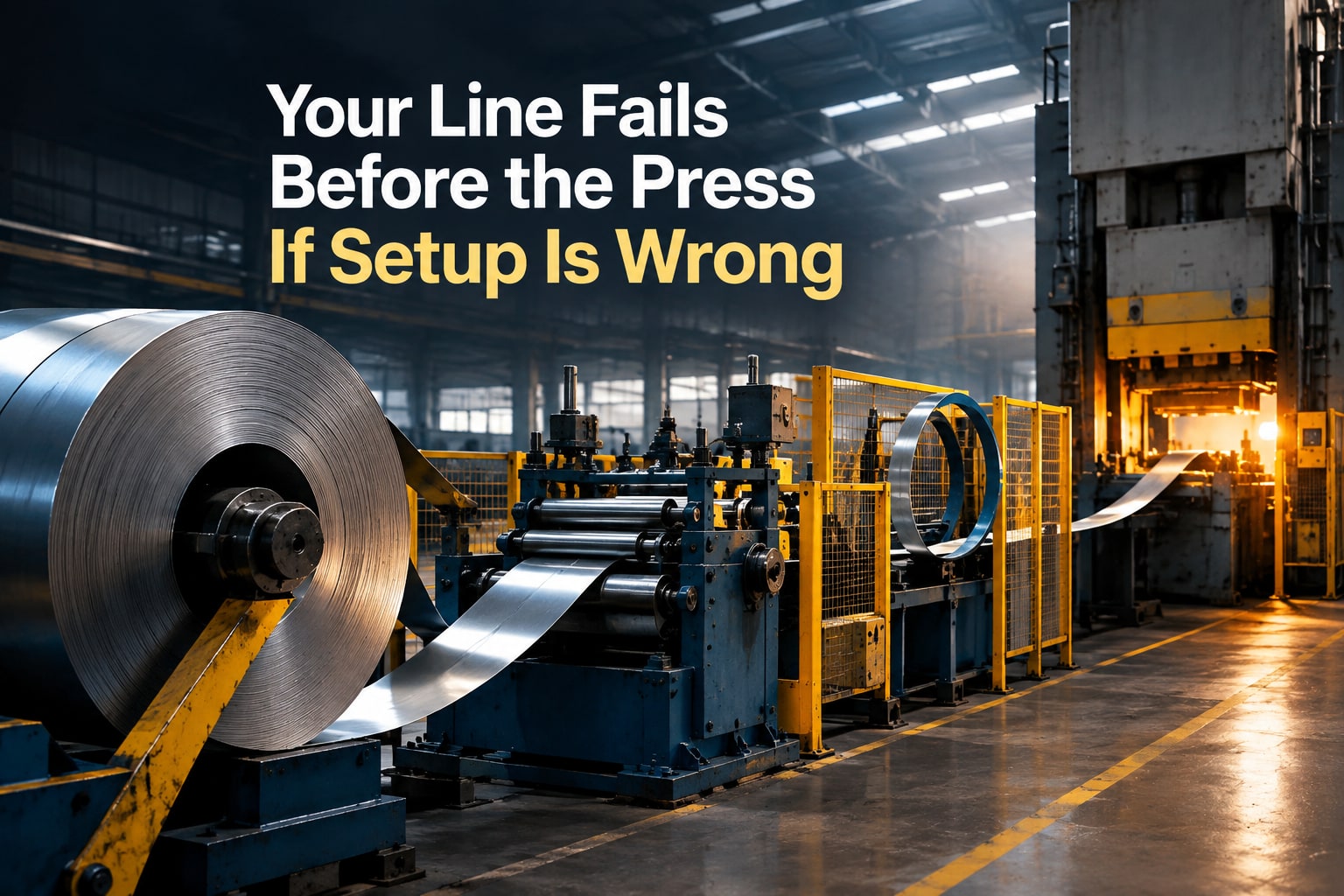
A production line can lose accuracy before the strip reaches the press if the coil, payoff, straightener, loop, and feeder are treated as one undifferentiated machine. By the end, you will know how to define the strip envelope, set operating conditions, select the right line configuration, and verify output under real plant conditions.
Key takeaways
- Confirm coil ID, OD, width, weight and strip thickness before sizing the machine.
- Verify crane capacity, floor space, power supply and line direction at the Chennai plant.
- Set payoff tension, loop control and straightening rolls gradually to prevent strip damage.
- Demand a documented trial proving speed, flatness, threading and emergency-stop performance.
How the Strip Moves from Coil Loading to Press Entry
Lift the coil with rated crane or lifting equipment, set it squarely on the payoff mandrel, and verify the measured coil ID before expanding it. Expand the mandrel only across the actual ID tolerance; then lock it mechanically or hydraulically before releasing the lifting gear. This sequence is fundamental to coil straightening production equipment.
- Start the payoff brake or drive in controlled mode so the coil cannot overrun the line.
- Engage the pinch rolls to grip and advance the strip without crushing its edges.
- Thread the strip through the straightening rolls at low speed, using minimum practical penetration and checking both edges and the centre.
- Form a controlled entry loop between payoff and straightener. The loop absorbs speed differences during acceleration, deceleration, and coil eccentricity; a short loop creates tension spikes, while an uncontrolled loop can snag personnel or equipment.
- Use a pilot or servo feeder to meter feed pitch and synchronize strip movement with the press stroke.
- Enter the strip into the press only after the feeder confirms stable length and alignment.
| Function | What it does | Main control |
|---|---|---|
| Decoiling | Releases and controls coil rotation | Brake, drive, or dancer |
| Straightening | Applies controlled plastic bending through multiple rolls | Roll penetration and alignment |
| Press feeding | Meters pitch and matches the press stroke | Pilot or servo feed |
For coil-end changeover, slow the line, detect or secure the tail, isolate stored hydraulic, electrical, and rotational energy, then join or remove the next coil according to the process. Rethread at low speed. For decoiling machine operating conditions in Chennai, verify these controls against measured site conditions, not assumed settings.
Which Coil and Strip Specifications Determine Machine Capacity
A strip straightening machine must cover the complete incoming-material envelope, not nominal width alone. Record maximum coil mass; minimum and maximum coil ID and OD; strip width and thickness; grade; yield and tensile strength; crown; camber; weld-joint condition; permissible surface marking; target line speed; feed pitch; and required flatness.
- Estimate coil mass as material density multiplied by coil volume: steel about 7,850 kg/m³, stainless steel about 8,000 kg/m³, aluminium about 2,700 kg/m³, or the certified density for another alloy.
- Check mandrel expansion against both minimum and maximum bore limits. Calculate payoff torque from coil radius and strip tension, then verify motor or brake torque, coil inertia, acceleration, and braking distance.
A width-rated machine can fail when thickness or yield strength exceeds its straightener frame, roll load, or drive torque. Thin strip needs smaller roll diameter, fine pitch, more rolls, and independent adjustment; thick or high-strength strip needs larger rolls, wider support, and a stiffer frame to limit deflection.
| Material | Roll surface | Drive and straightening requirement | Main risk |
|---|---|---|---|
| Low-carbon steel | Hardened steel | Moderate torque; conventional multi-roll setup | Edge wave |
| Stainless steel | Polished, hard surface | Higher torque; controlled penetration | Galling and marks |
| Aluminium | Non-marking, polished surface | Low penetration; lighter tension | Overworking and scratches |
| Galvanized strip | Smooth, protected surface | Gentle rolls and controlled speed | Coating damage |
| High-strength steel | Hardened rolls | High torque; rigid frame and larger rolls | Roll deflection and residual stress |
Set line speed with coil inertia, weld passage, press synchronization, and feed pitch—not the empty-machine rating.
What Chennai Plant Conditions and Line Configuration Must Be Confirmed
A site survey must measure Chennai conditions before specifying the line: ambient temperature, seasonal humidity, airborne dust, coastal salt exposure, ventilation, floor loading, foundation depth, anchor layout, crane access, drainage, and water or coolant near panels. Record plant voltage, phase balance, frequency, earthing, short-circuit level, voltage disturbances, and compressed-air pressure, flow, filtration, and dew point.
- Match the control-panel enclosure, filtered ventilation or heat exchanger, connector protection, exposed-part corrosion control, and hydraulic oil viscosity, filtration, relief settings, reservoir capacity, and allowable oil temperature to those measurements.
- The phrase decoiling machine operating conditions in Chennai must mean measured site data, not a generic indoor rating.
- Compare the line choices below before ordering:
| Option | Throughput/feed accuracy | Footprint/labour | Changeover, controls, maintenance, downtime |
|---|---|---|---|
| Simple decoiler | Low; operator-controlled feed | Small; high labour | Fast changeover; minimal controls; low maintenance, but stoppages at each coil |
| Decoiler with pinch rolls | Moderate; steadier feed | Moderate; less labour | Moderate changeover; basic controls; pinch-roll wear can stop production |
| Decoiler-straightener | Moderate-high; improved flatness | Larger; lower handling labour | Longer setup; synchronized controls; roll and hydraulic maintenance |
| Full coil line with servo feeder | Highest; precise pitch | Largest; lowest manual feeding | Recipe-based changeover; advanced controls; more maintenance and fault-related downtime |
A standard de-coiling cum straightening machine is unsuitable for very narrow strip, unusually high-strength material, fragile coatings, severe flatness limits, very-high-speed stamping, welded joints that cannot pass the roll gap, or irregular batches better served by separate equipment.
Hydropower Engineers can reduce travel and service time, but de coiling cum straightening machine conditions in Chennai still require matched coil and press data.
Related product
 | Decoiling cum Staraightening Machine Decoiling cum Staraightening Machine De-coiling machines are essential press-feeding equipment used to handle sheet metal in the form of large coils from rolling mills. View product → |
How to Set Rolls, Loop Control, and Safety Systems Without Damaging Strip
Thread at crawl speed with minimum practical roll penetration. Set the decoiler, entry guides, straightener, and exit guides on one centerline; misalignment causes edge damage and unstable tracking. Run a trial piece, inspect both edges and the center, then increase penetration in small steps.
- Correct residual bow, camber, or coil memory through payoff alignment, guide position, loop tension, and roll settings; do not force severe edge wave or center buckle through the final rolls.
- Retune dancer or loop control after every speed change: insufficient control creates an impact loop, while excessive back-tension masks poor straightening and increases strip stress.
- Detect welded joints and slow, bypass, or remove them when weld reinforcement, flash, burrs, or thickness could overload a roll. Synchronize pilot and servo feed signals before increasing speed.
Straightening applies plastic bending; tension control only regulates strip force and loop stability. Excessive penetration can overwork aluminium, stainless steel, galvanized coating, or high-strength steel, producing marks, edge wave, center buckle, residual stress, or shortened roll life. These checks belong in the strip straightening machine requirements for any coil straightening production equipment.
| Setting | Correct action | Failure if wrong |
|---|---|---|
| Entry and exit alignment | Keep all centers on one line | Camber, edge damage, tracking faults |
| Roll penetration | Increase incrementally on a trial piece | Marks, overload, distorted strip |
| Loop and feed | Match dancer, pilot, and servo timing | Tension spikes or unstable feed |
Fit fixed or interlocked guards around coil perimeters, shafts, pinch points, and roll gaps; emergency stops do not replace them. Restrain coils, lock the mandrel, and isolate hydraulic, rotating, suspended, and electrical energy before threading, jam clearing, coil changes, or roll replacement.
Check lubrication, leaks, oil contamination, bearings, belts, rolls, sensors, electrical connections, and sensor cleanliness routinely.
How to Prove Performance, Plan Installation, and Choose a Supplier
Before sign-off, run a representative sample coil for each critical material grade at maximum intended production speed, actual press stroke rate, stop-start cycles, and coil-end handling.
State strip tension, coil position, speed, and measurement method, then record width, thickness, crossbow, edge wave, center buckle, longitudinal bow, residual camber, flatness, surface marks, feed-length repeatability, scrap rate, and press alignment. “Straightened output” is not an acceptance criterion without limits.
Require setup recipes, operating limits, manuals, electrical and hydraulic drawings, risk assessment, operator training, spare rolls and sensors, lubrication schedules, recommended wear parts, and a named service response process.
Your strip straightening machine requirements package must include material properties, strip profile, coil dimensions and mass, feed pitch, press tonnage and stroke rate, target speed, duty cycle, allowable marks, utilities, layout, foundation and documentation needs.
For de coiling cum straightening machine conditions in Chennai, price foundation preparation, crane access, common-centerline alignment, trial coils, commissioning, and setup training. Add planned maintenance, roll replacement, changeover labour, and downtime.
| Option | Strength | Cost or risk to compare |
|---|---|---|
| Manual handling | Lowest equipment complexity | Labour, injury exposure, slow changeovers |
| Separate decoiler plus straightener | Modular replacement and flexible routing | Extra controls, footprint, alignment and transfer downtime |
| Integrated line | Coordinated feeding and repeatable recipes | Higher capital, specialist maintenance; integration does not guarantee lower operating cost |
Frequently asked questions
What specifications determine de-coiling and straightening machine capacity?
Confirm coil inside diameter, outside diameter, maximum weight, strip width, thickness, material grade, yield strength and required line speed.
What Chennai plant conditions must you confirm before installation?
Check available floor area, foundation and anchor points, crane access, electrical supply, compressed air, ventilation, material flow and press-entry height.
How do you prevent strip damage during straightening?
Centre the coil, match the mandrel to the measured ID, control the loop, thread the strip correctly and adjust roll penetration in small steps.
How can you prove a supplier's machine will meet production requirements?
Run representative coils during a witnessed trial and record threading time, line speed, strip flatness, surface condition, scrap and safety-system operation.