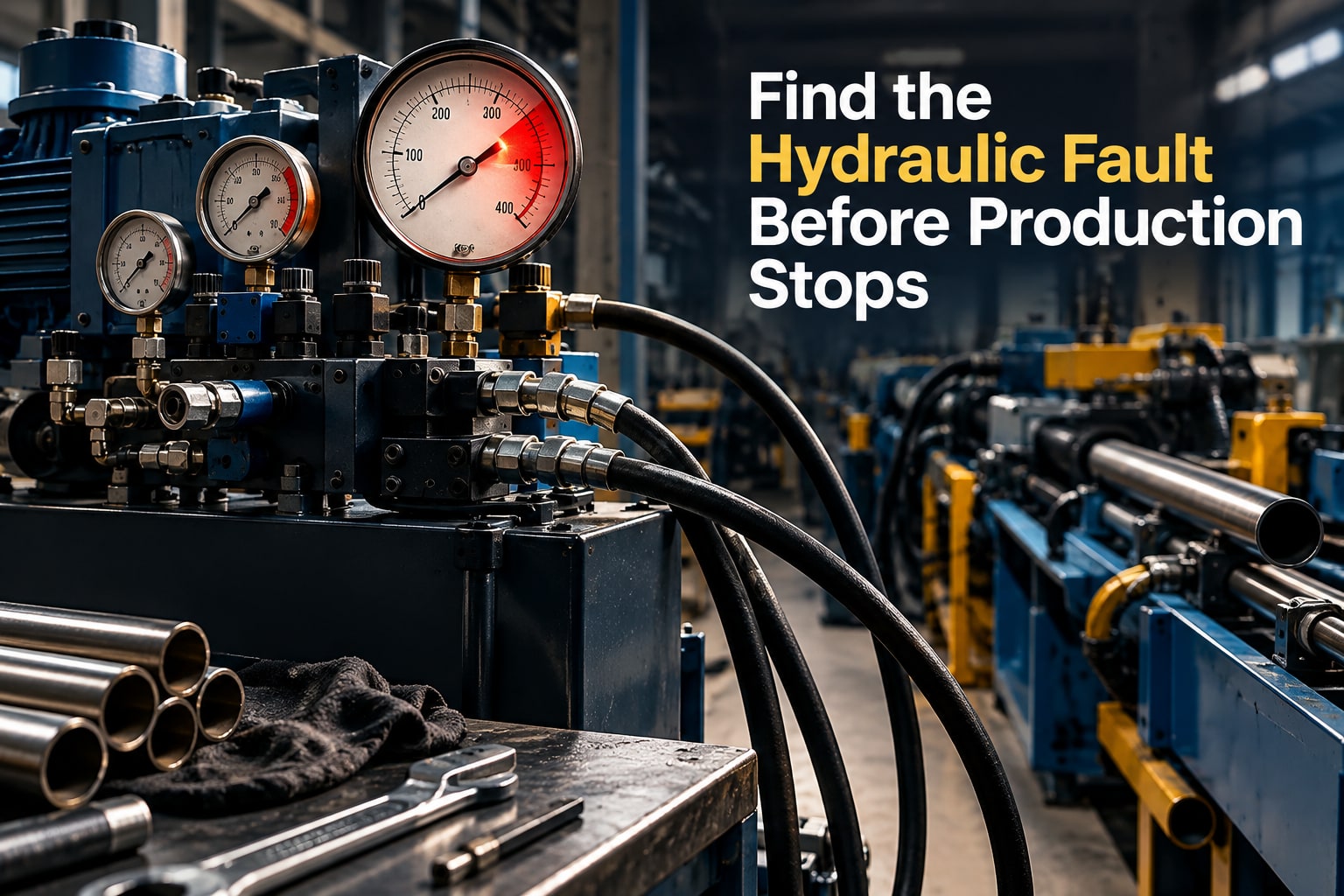
A hydraulic fault does more than stop a machine: it can lengthen cycles, reduce forming force, damage components, increase energy use, and create unsafe conditions. You will be able to connect production symptoms to likely causes, follow a safe troubleshooting sequence, and judge whether repair evidence proves the system is ready to return to service.
Key takeaways
- Check pressure and flow under operating load, not only at idle.
- Compare oil temperature, filter restriction and reservoir level with machine limits.
- Isolate electrical, pump, valve, cylinder and contamination faults before replacing parts.
- Choose repair based on downtime risk, component condition and available replacement support.
How hydraulic faults become production losses
Hydraulic faults become production losses when a machine cannot deliver stable force, speed, or position at the required time. Hydraulic power problems affecting industrial production systems include pressure loss, insufficient flow, overheating, contamination, air ingress, leakage, electrical control faults, cylinder drift, pump damage, and unstable motion.
Use the capacity relationship P = p × Q / 600: P is power in kW, p is pressure in bar, and Q is flow in L/min. Adequate pressure with inadequate flow creates slow cycles because the machine reaches force too slowly. Adequate flow with insufficient pressure produces incomplete clamping, piercing, bending, or forming.
The production effects are direct:
- Longer cycle times and incomplete strokes reduce hourly output.
- Poor positioning and unstable motion create dimensional variation and rejected parts.
- Leakage, cylinder drift, or control faults cause unplanned stoppages and safety exposure.
- Restricted flow, bypassing relief valves, and damaged pumps increase energy consumption by turning power into heat.
- Pressure spikes, contamination, and air ingress can damage valves, seals, cylinders, tooling, and connected machinery.
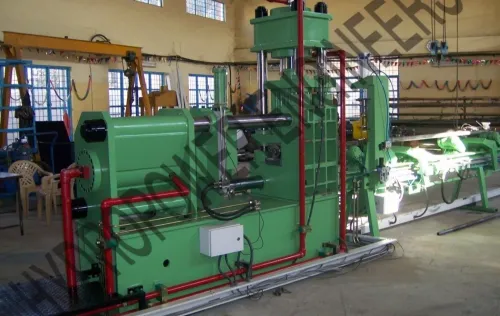
Industrial hydraulic system issues in tube-processing machines require pressure and timing checks at the clamp, carriage, mandrel, and forming circuits. A nominal peak-pressure reading alone does not prove dimensional repeatability: delayed clamp release, pressure decay, or leakage can move the tube or alter force between cycles.
What each production symptom points to
A symptom narrows the search, but it does not prove the failed component. Use this hydraulic power pack troubleshooting table to separate pressure, flow, air, heat, and electrical faults.
| Symptom | Points to | Check first |
|---|---|---|
| Low pressure | Relief valve partly open, blocked filter, undersized hose, or incorrect load requirement | Compare pump-outlet and actuator-port pressure |
| Noisy pump | Cavitation from suction restriction or poor inlet conditions | Look for crackling noise, vibration, and pump erosion |
| Foamy oil | Air entrainment from low reservoir level, poor return-line arrangement, loose fittings, or damaged seals | Inspect oil surface, fittings, and suction connections |
| Hot reservoir | Continuous relief-valve bypass, internal leakage, blocked cooler, or high ambient heat | Confirm bypass flow and oil temperature |
| Slow actuators | Partly open relief valve, blocked filter, undersized hose, worn cylinder seals, or faulty directional valve | Measure flow under load |
| Jerky movement | Air entrainment, sticky directional valve, contamination, or worn seals | Check for spongy movement and foamy oil |
| Pressure spikes | Incorrect accumulator precharge, sticking valve, or blocked return path | Test accumulator precharge with dry nitrogen |
| External leaks | Damaged hose, loose fitting, failed seal, or cracked tube | Inspect without touching pressurised oil |
| Internal leakage | Worn cylinder seal, directional valve spool, or cartridge bypass | Run a timed pressure-decay test |
| Failure to start | Motor electrical fault, control interlock, seized pump, or low oil level | Check supply, starter or VFD faults, and rotation |
Cavitation produces crackling noise, vibration, and erosion; air entrainment produces foam and spongy movement. A pressure gauge alone cannot identify worn-pump leakage, restricted valves, or actuator bypassing.
- Record pressure, flow, temperature, and cycle time at the same load.
- Isolate the actuator before testing internal leakage.
- Stop operation if heat rises rapidly or a leak is pressurised.
A safe sequence for hydraulic power pack troubleshooting
1. Apply lockout/tagout before hydraulic power pack troubleshooting. Isolate electrical supply, hydraulic pressure, accumulator energy, suspended loads, and trapped pressure between valves. Mechanically support every raised load, then verify zero pressure at each relevant gauge and test point. Never search for a pinhole leak with your hand; use cardboard or a suitable shield.
2. Check reservoir level and oil appearance. Milky oil indicates water; foam points to air ingress; darkened oil or visible metal demands contamination investigation. After safe hydraulic isolation and depressurization, check accumulator precharge with dry nitrogen only—not oxygen or shop air—at the specified pressure and temperature.
3. Inspect suction strainers, inlet hoses, fittings, and other restrictions. A blocked inlet can starve the pump and cause crackling noise, vibration, and erosion.
4. Verify motor rotation, electrical supply, starter or VFD status, and motor speed. Incorrect rotation or low speed can imitate a failed pump.
5. Read pressure at the pump outlet and specified actuator test points under the same load. Then measure flow under that identical operating condition. Pressure without flow data cannot expose worn-pump leakage, a restricted valve, or actuator bypassing.
6. Inspect return-line filter indicators and confirm bypass status. Observe whether the relief valve continuously bypasses; a partly open valve converts flow into heat and causes low force and slow motion.
7. Separate pressure faults from flow faults before replacing the pump. Adequate pressure with inadequate flow produces slow cycles, while adequate flow with insufficient pressure produces weak actuation. This order prevents industrial hydraulic system issues from being misdiagnosed as pump failure.
Measurements that identify the real failure
Create one service record before changing a component. Record:
1. Pressure at idle and under load, pump-outlet pressure, actuator-port pressure, flow rate, oil temperature, ambient temperature, motor current or starter/VFD fault code, motor speed, reservoir level, filter differential pressure, cylinder cycle time, pressure-decay time, and leakage rate.
2. Repeat those readings under the same load and operating condition. Low pump-outlet pressure with low flow indicates a pump or suction problem; normal outlet pressure with low actuator pressure points to a blocked filter, undersized hose, faulty directional valve, or incorrect load.
A relief valve set too low shows outlet pressure stopping at its setting while flow diverts and oil heats. Normal pump readings with actuator-port pressure decay, drift, or high leakage indicate a worn cylinder seal or valve bypass.
3. Compare the measured load with the machine’s required force. A pressure gauge alone misses worn-pump leakage, restricted valves, and actuator bypassing.
Oil temperature belongs beside every reading. Excessive viscosity increases suction loss, cold-start torque, and pressure drop; thin oil increases internal leakage and can stop an actuator holding position. Use the pump, valve, seal, and fluid manufacturers’ viscosity and temperature limits, not ISO VG grade alone.
For industrial hydraulic system issues, sample fluid for metal, water, dirt, and aeration. Replace filters, clean reservoirs, and prevent ingress during hose replacement. Set the component-required ISO 4406 cleanliness target; a nominal micron rating does not prove cleanliness. Record ambient heat and humidity when investigating hydraulic power system problems in Chennai.
How to evaluate repair decisions in Chennai
Treat hydraulic power system problems in Chennai as site-condition problems as well as component failures. Record ambient heat and humidity, cooler margin, water ingress, reservoir temperature, reservoir level, unstable electrical supply, motor current, starter or VFD fault codes, and filter-indicator status before approving replacement work.
1. Justify hydraulic equipment repair in Chennai only when the scope identifies the measured cause, not merely “pump serviced” or “valve replaced.” Compare pre-repair and post-repair pressure, flow, temperature, leakage, and cycle time under the same load.
2. Check the replacement component against the machine’s duty: rated pressure, flow capacity, seal material, and hydraulic-fluid compatibility. A mismatched seal or undersized valve can recreate leakage, heat, or slow motion immediately.
3. Require system-level testing on customized machinery. For tube-processing equipment, compare pressure and timing at the clamp, carriage, mandrel, and forming circuits, not only at the power-pack gauge. Hydropower Engineers is one example of a manufacturer or service partner whose value should be judged by those measured results.
4. Reject a “repair” that omits contamination removal, relief-valve verification, suction checks, or electrical diagnosis. A new pump can fail again, while a blocked suction path, misadjusted relief valve, contaminated oil, or motor fault leaves the production problem unresolved.
Use a timed pressure-decay or leakage test when drift or lost clamping force suggests internal bypassing. The test can expose a worn cylinder seal or directional valve even when pump pressure and flow are correct.
Related products
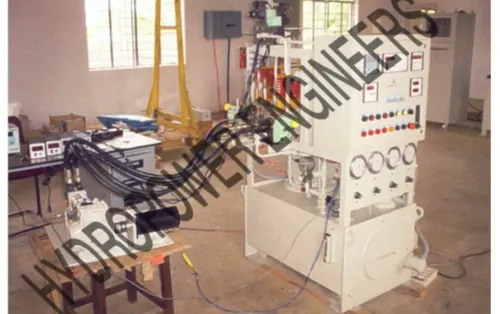
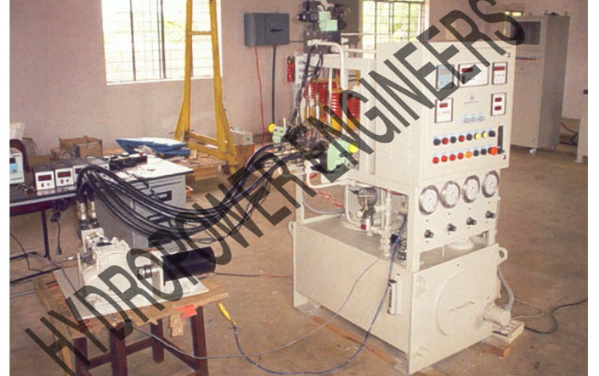 | Hydraulic Power Pack Hydropower Engineering Systems offers high-performance Hydraulic Power Packs designed to meet a wide range of industrial application requirements... View product → |
 | Hydraulic Testrig Hydropower Engineering Systems offers advanced Hydraulic Test Equipment designed for precise testing and evaluation of automobile components and... View product → |
Frequently asked questions
How do hydraulic faults become production losses?
Pressure loss, insufficient flow, overheating, contamination, air ingress, leaks and control faults reduce force, speed or positioning accuracy. The result is slower cycles, rejected parts, unplanned stoppages or unsafe operation.
What does unstable hydraulic motion point to?
Check for air in the oil, contaminated or sticking valves, pump flow fluctuation, loose suction connections and incorrect flow-control settings. Record symptoms at a consistent load before changing components.
What is a safe sequence for hydraulic power pack troubleshooting?
Stop the machine, isolate electrical and hydraulic energy, release stored pressure and prevent unexpected movement. Inspect oil level, leaks, hoses, filters and wiring before measuring pressure, flow and temperature.
Which measurements identify the real hydraulic failure?
Measure pressure at defined test points, flow under load, oil temperature, filter restriction, reservoir level and cylinder or motor speed. Compare readings with the machine’s schematic and component ratings.
How should you evaluate hydraulic equipment repair in Chennai?
Compare repair scope, component condition, testing evidence, replacement lead time, commissioning support and downtime exposure. Ask whether the provider can diagnose the complete power unit and connected production equipment.
Related products
 | Portable Mobile Hydraulic Power Unit Portable Mobile Hydraulic Power Unit Power your operations anywhere with the Portable Power Unit from Hydropower Engineering Systems, a highly efficient mobile hydraulic power solution... View product → |
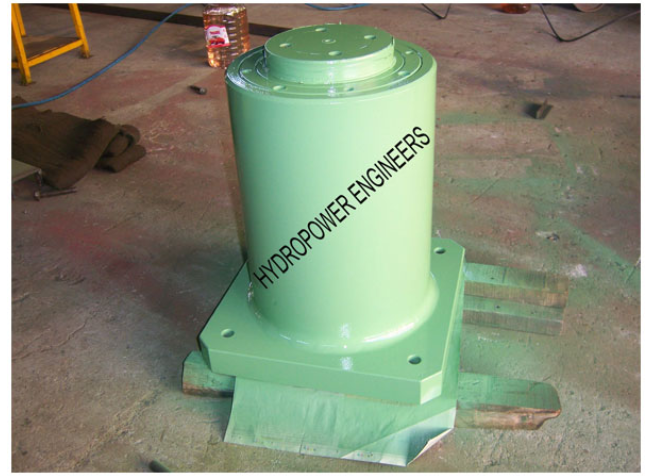 | Hydraulic Lift Hydropower Engineering Systems offers durable and high-performance Hydraulic Jacks designed for lifting heavy loads with ease and precision. View product → |
 | Special Equipments The Hydraulic Winch from Hydropower Engineering Systems is a powerful and reliable solution designed for efficient hoisting and hauling operations... View product → |
 | Special Equipments from Hydropower Engineering Systems are precision-engineered devices designed to convert fluid power into efficient rotary motion and torque for a... View product → |