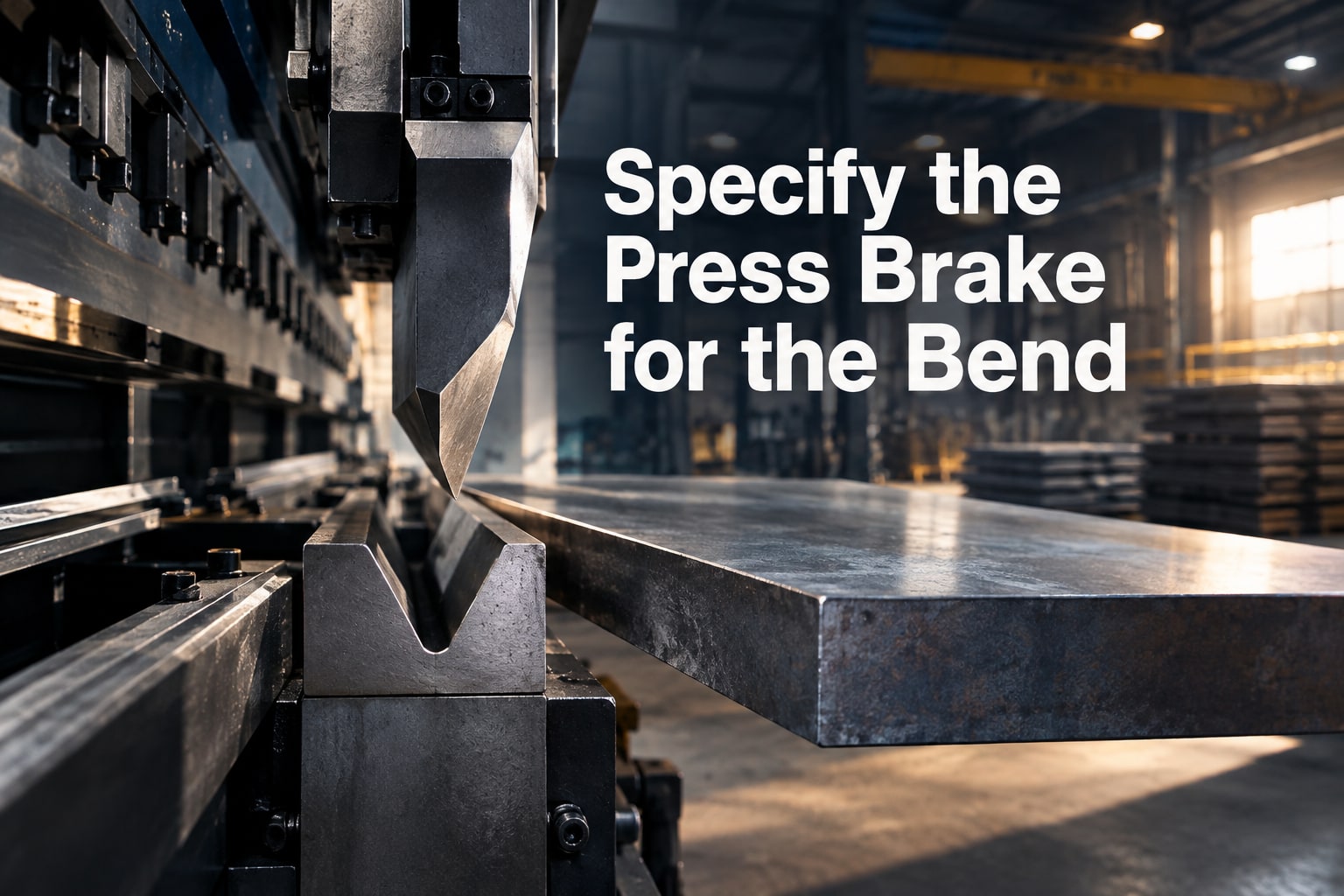
A machine’s tonnage alone cannot tell you whether it will bend your plate safely, accurately, and across the full bed length. By the end, you will be able to compare force calculations, tooling, speed, control accuracy, utilities, safety documentation, and service support against your actual fabrication work.
Key takeaways
- State force by bend length, not only total machine tonnage.
- Calculate tonnage from material strength, thickness, bend length, and die opening.
- Match V-dies, tooling, and bending method to the finished part.
- Confirm floor loading, guarding, controls, and service support before purchase.
Build a Specification Sheet That States Usable Capacity
A usable capacity sheet starts with nominal force in tons or kN, then proves where that force is safe. Do not treat an industrial hydraulic press brake as a single headline tonnage: load distribution across the bed determines whether the machine can bend your part without frame or tooling damage.
Request these press brake machine specifications:
- Nominal force, force-rating basis, working length, distance between frames, maximum stroke, daylight opening, throat depth, bed width, table width, minimum and maximum die height, allowable concentrated load, and motor power.
- State whether rated force applies across the complete bed or only within a defined load zone, at which die opening, and at what distance from each side frame.
- Record hydraulic working pressure, cylinder effective area, and cylinder arrangement separately. Pressure and cylinder area establish force; pump flow mainly controls rapid approach, working or bending speed, and return speed.
- Require rapid-approach speed, working speed, return speed, and a documented capacity margin. Do not match calculated force exactly; reserve capacity for material variation, friction, and load concentration.
| Specification | What it tells you | Failure if ignored |
|---|---|---|
| Force system | Pressure × effective cylinder area, with cylinder count and arrangement | Pump flow is mistaken for extra tonnage |
| Geometry | Stroke, daylight, throat, die heights, and widths | Tooling or deep work cannot fit |
| Load limits | Full-bed rating, load zone, die opening, frame distance, concentrated-load limit | A local load overloads the bed despite adequate nominal tons |
Calculate Tonnage for the Material, Bend, and Die Opening
Start with an air-bending estimate, not the press’s headline tonnage. The result is a sizing reference; tooling geometry, friction, material condition, and load distribution can change the actual force.
1. Identify the job: grade and tensile strength, thickness, inside radius, bend length, V-die opening, and bend type. For example: S355 steel at 510 N/mm² tensile strength, 20 mm thick, 2,000 mm bend length, 27 mm inside radius, 160 mm V opening, air bending.
2. Use this starting estimate:
Air-bending force (N) = 1.42 × tensile strength (N/mm²) × bend length (mm) × thickness² (mm²) ÷ V opening (mm)
For the example: 1.42 × 510 × 2,000 × 20² ÷ 160 = 3,621,000 N, or about 3,621 kN (369 tonnes-force). Treat this as an estimate, not a guaranteed rating.
3. Compare the result with the supplier’s published capacity chart, then add a documented capacity margin. The chart must name the material grade, thickness, bend length, and V opening. Confirm whether its force applies across the full bed or only within a defined load zone.
Do not select a heavy metal bending press by thickness alone. Stainless steel, plate, and high-strength steel can have higher yield and tensile strengths than mild steel, increasing force; high-strength grades also increase springback. Control angle through the radius, die opening, and controlled overbending—not extra tonnage alone.
A larger V opening lowers force but increases radius; a smaller opening raises force and risks marking or overload.
Bottoming and coining require separate checks. Coining can require several times the force of air bending.
Match Tooling and Bending Method to the Finished Part
Specify a 88° or 90° punch to suit the finished angle, with a nose radius matched to the required inside radius and material thickness.
Select the V-die opening, die shoulder radius, and tool length from the supplier’s load chart; a larger V opening generally lowers force and increases inside radius, while a smaller opening raises force and can overload the machine.
| Method | Force demand | Accuracy and springback | Wear and damage |
|---|---|---|---|
| Air bending | Lowest; use the published chart | Good, but needs overbending for springback | Lowest wear; broad V reduces marking |
| Bottoming | Higher than air bending | Better angular control and less springback | Greater wear; marking or local crushing risk rises |
| Coining | Several times air-bending force | Highest angle repeatability and minimal springback | Severe tool wear; high local-crushing risk |
For a heavy metal bending press, state maximum tool height, usable tooling length, segmented or full-length sections, clamping method, and compatibility with European, American, or another named standard.
Confirm that punch and die lengths fit the bed and that the clamp accepts the selected profile; a mismatch can leave unused capacity or eject tooling under load.
Treat tube work as a separate process. Specify:
- Outside diameter or section size, wall thickness, material, bend radius, and required angular tolerance.
- Support or mandrel arrangement, allowable ovality, and dimensional tolerance after bending.
Open dies can flatten or buckle thin-wall tube at punch and shoulder contact points. Flat-plate tooling data cannot certify tube bending; require tube-specific trials or calculations.
Specify Control, Accuracy, and Deflection Compensation
A productive press brake is defined by controlled motion and measured results, not a large force rating. Specify these press brake machine specifications:
- State the backgauge axis count: 2-axis, 4-axis, or 6-axis control; maximum sheet support length and load; positioning accuracy; and repeatability.
- On a two-cylinder machine, require synchronized Y1/Y2 ram control. Ask whether proportional valves, linear scales, or equivalent feedback correct unequal cylinder movement and frame deflection.
- Separate ram parallelism, unloaded positioning accuracy, repeatability under load, and finished bend-angle repeatability. The supplier must state the test load, bend length, material, tooling, temperature, reference point, and measurement method for each figure.
- Specify mechanical or hydraulic crowning, its compensation range, and integration with the CNC. Confirm whether the quoted accuracy and bending capacity assume crowning is installed and operating.
- Require the control to display or record Y1/Y2 position, backgauge position, crowning value, alarms, and calibration status.
Equal hydraulic pressure does not guarantee a level ram. Feedback-controlled synchronization keeps both cylinders at the commanded position, while proportional valves meter movement instead of relying on crude full-flow switching.
Test a long sample bend during acceptance. Measure angle and key dimensions at the centre and both ends; frame and bed deflection can make the centre tighter or looser even when CNC positions are correct. Reject any specification that gives accuracy without its test condition and measurement method.
Compare Site Readiness, Safety, and Local Support Before Purchase
Before ordering hydraulic press brake specifications in Chennai, verify the machine against your actual site, safety records, and service capability—not an assumed three-phase 415 V, 50 Hz supply.
- Electrical: supply voltage, phase, frequency, full-load current, short-circuit protection, and earthing arrangement.
- Hydraulic: oil grade, reservoir volume, filtration rating and replacement interval.
- Environment: permitted ambient operating range, ventilation, dust control, and cooling requirements.
| Check | Require in the quotation | Consequence if missing |
|---|---|---|
| Site readiness | Confirm measured site supply and utility limits | Incorrect power data causes trips, overheating, or installation delay |
| Safeguarding | Front and rear guards, emergency stopping, unintended ram-descent prevention, maintenance isolation, and hydraulic and electrical failure protection | Access or component failure can create crushing and shock hazards |
| Compliance file | Applicable ISO 16092-1 and EN 12622 documents, risk assessment, declaration, and safety-circuit records | You cannot verify the machine’s safety design or acceptance basis |
| Local support | Commissioning, operator training, calibration, preventive-maintenance intervals, warranty exclusions, and fault response times | Production stops while basic adjustments or repairs wait |
Evaluate a press brake manufacturer in Chennai by asking for locally available tooling, hydraulic filtration support, spare proportional valves and seals, and the exact CNC and hydraulic components quoted. Confirm whether calibration covers ram parallelism and angle accuracy, and obtain written response times for control and safety faults.
Ask Hydropower Engineers to document every item for the quoted configuration, then compare suppliers by evidence rather than tonnage and bed length alone.
Frequently asked questions
What should a hydraulic press brake specification sheet include?
List rated force in tons or kN, usable force by bend length, bed length, stroke, daylight, throat depth, die opening, tooling, controls, accuracy, deflection compensation, safety systems, power supply, floor loading, and service requirements.
How do you calculate press brake tonnage for heavy metal bending?
Use the material tensile strength, sheet thickness, bend length, and selected die opening in the tonnage formula. Check the result against the machine’s rated load and confirm that the load distribution stays within the manufacturer’s limits.
How do die opening and tooling affect press brake specifications?
The V-die opening affects required force, inside bend radius, flange length, and risk of marking or cracking. Select punch and die geometry from the material, thickness, bend angle, and finished-part dimensions.
What should you check before installing an industrial hydraulic press brake?
Confirm floor capacity, machine footprint, working clearance, electrical supply, lifting access, guarding, emergency stops, operator visibility, foundation requirements, commissioning, spare parts, and local service coverage.