A force rating alone cannot tell you whether a compactor will accept your containers, achieve the required final size, or process the daily waste volume. By the end, you will have a specification checklist, a capacity-selection method, Bangalore installation requirements, safety and compliance questions, and an acceptance test for comparing suppliers.
Key takeaways
- Separate ram force from chamber volume and complete-cycle throughput.
- Calculate capacity from your actual waste stream and feed weight.
- Specify guarding, interlocks, isolation points and Bangalore site conditions.
- Confirm waste compatibility and authorized disposal routes before purchase.
The specification sheet you should demand
A specification sheet must separate pressing force from usable capacity. Hydraulic compactor capacity depends on chamber volume, feed weight, compressed output and complete-cycle throughput; a 100-tonne ram does not prove any of them. Demand figures measured with your waste, not catalogue force alone.
Ask the supplier to state:
- Rated force in tonnes or kN, force per projected loading area, stroke length and daylight
- Usable chamber dimensions, platen size, feed opening and maximum bale, drum or container dimensions
- Chamber volume in m³, maximum compacted mass per cycle in kg and rated payload
- Hydraulic working pressure, pump flow, oil-tank volume, motor rated power, starting method and electrical load
- Unloaded cycle time and witnessed complete cycle time, including loading, ram return, door operation, handling and re-strokes
- Demonstrated throughput in kg/h, output density or compressed volume, and power consumption
- Machine footprint, operating height, floor loading, noise level and safety-interlock requirements
| Rated figures | What they establish | What they do not establish |
|---|---|---|
| Pressing force | Maximum ram force | Throughput or compressed mass |
| Chamber volume | Space available before compression | Final output volume |
| Cycle time | Hydraulic movement duration | Loading and handling time |
| Throughput | Material processed per hour | Performance with different waste |
| Motor power | Drive size and electrical demand | Hydraulic force without pressure and flow |
Require test results for cold starts, repeated cycles, leaks, emergency-stop response and interlocks. Confirm nominal voltage, phase, frequency, short-circuit capacity, earthing and cable-route requirements against the Bangalore site supply before approving the sheet.
How to calculate capacity from your waste stream
Choose hydraulic compactor capacity from kilograms and cubic metres per shift, not tonne-force alone. Record seven days of waste, including the busiest day, then separate normal feed from peak loading. A machine rated at 50 tonne-force can still underperform if its feed opening causes bridging or its cycle is too slow.
Use this calculation sequence:
- Weigh each waste type and calculate loose bulk density in kg/m³. Record moisture, packaging, drum size and the largest item entering the chamber.
- Set chamber volume from the normal load per cycle, leaving room for safe loading. Do not use the chamber’s full geometric volume as usable payload.
- Calculate required throughput: kilograms per cycle × 3,600 ÷ cycle time in seconds. Compare that figure with demonstrated throughput, not the supplier’s theoretical rate.
- Check maximum compacted mass per cycle, container or bale dimensions, and the final output size against your transport and storage limits.
- Compare pressing force per projected platen area. Force alone proves neither chamber capacity nor output density; cylinder force follows F = pA, while friction, pressure loss and linkage geometry reduce the force reaching the waste.
| Measure | Use in sizing | What goes wrong if ignored |
|---|---|---|
| Daily and peak mass | Sets required kg/h and buffer capacity | Queues form during peak shifts |
| Loose volume and density | Sets chamber volume and feed size | The chamber fills before the target mass is reached |
| Cycle time and loading method | Establishes practical throughput | A high-force machine needs repeated manual redistribution |
Write the industrial hydraulic compactor specifications around these measured values, including hydraulic compactor capacity as chamber volume, payload, cycle time and proven kg/h—not as a single force rating.
Bangalore operating conditions, installation and machine safety
A Bangalore installation must be designed for its actual site supply, not a generic catalogue voltage. Confirm nominal voltage, phase, frequency, short-circuit capacity, earthing arrangement, cable route and allowable voltage drop; motor starting failures and unreliable controls follow when these details are ignored.
State motor rated power and starting method separately from hydraulic pressure and flow.
Record the hydraulic compactor operating conditions in the purchase document:
- Design ambient-temperature range, humidity exposure and ventilation requirement
- Indoor, sheltered-outdoor or fully outdoor location, including monsoon splash and drainage
- Dust exposure, permissible moisture and contamination-control method for hydraulic oil
- Oil temperature range, specified viscosity grade and cold-start requirement
- Duty cycle, cycles per hour and heat-rejection provision during repeated operation
- Floor loading, anchor arrangement, service clearances and access for lifting equipment
- Chamber, container and discharge alignment, with no need for manual entry into the feed zone
Apply ISO 4413 principles to pressure limitation, stored-energy isolation, hose restraint, guarding and maintenance access. Fit a lockable main isolator, hydraulic pressure-relief protection, guarded moving parts, an emergency stop that removes hazardous motion, and interlocks that prevent cycling with an open gate. Never treat an emergency stop as energy isolation.
Acceptance testing should include cold start, repeated-cycle temperature rise, leak inspection, emergency-stop response, interlock verification, noise, power consumption and output density using the buyer’s actual waste. Factory pressure testing alone cannot prove safe throughput at the Bangalore site.
Match the machine to the waste and its legal route
An empty drum is not automatically safe to compact. Residual solvent, oil, paint, gas or pressure can turn a routine press cycle into a fire, toxic release or projectile event.
| Waste stream | Machine requirement | Handling and legal route |
|---|---|---|
| Empty drums | Accept only verified depressurised, drained and decontaminated drums; specify drum diameter, height and anti-rolling restraints. | Obtain a cleaning or decontamination record. Route contaminated drums through the authorised hazardous-waste channel; do not feed sealed drums. |
| Industrial scrap | Use a wide feed opening, guarding against sharp edges and a platen suited to the scrap shape. Keep cylinders, batteries, sealed vessels and pressurised cans out. | Segregate ferrous, non-ferrous and mixed scrap. Send recyclable metal to the documented recycler rather than treating mixed scrap as municipal waste. |
| Hazardous containers | Do not select ordinary municipal equipment. Require compatible seals, vapour control, remote operation and a written approval for the specific residue. | Classify the residue under India’s Hazardous and Other Wastes Rules, 2016, then use an authorised collection, treatment, storage or disposal route. |
| Radioactive-material containers | Do not compact them with an industrial waste press. Ordinary guarding and force ratings provide no radiation control. | Stop handling, isolate the item and contact the site Radiation Safety Officer and the authorised facility or regulator route under Atomic Energy Act controls. |
For approved scrap only, state hydraulic compactor capacity by chamber volume, maximum mass per cycle and demonstrated throughput. Record hydraulic compactor operating conditions, including dust, moisture, oil temperature and duty cycle, because contamination from the wrong stream can damage valves and expose operators.
Require waste-specific trials; a quoted compaction ratio proves nothing for a different material.
Verify performance before approving the purchase
Approve a supplier only after a witnessed acceptance test using your waste, operators, container and electrical supply. Weigh each load before compaction, weigh the output, measure its occupied volume, and calculate volume reduction and output density; a force rating or factory pressure certificate proves neither result.
Compare every “hydraulic compactor manufacturer bangalore” quotation against the same test script:
- Start the machine cold and record time to ready state, motor starting behaviour and the first complete cycle.
- Run repeated loaded cycles until hydraulic-oil temperature stabilises; record cycle time, power consumption, leaks, noise and re-strokes.
- Test the emergency stop, guards, door and container interlocks, ram return and energy isolation. Record response and any fault.
- Repeat the test with the agreed waste mix, moisture level and peak feed weight, then calculate demonstrated throughput in kg/h.
Hydropower Engineers can be asked to provide this evidence in the same format as competing bids, making the comparison auditable rather than brochure-led. File the signed results with the hydraulic compactor specifications in Bangalore Division.
| Supplier evidence | What it proves | Reject if |
|---|---|---|
| Witnessed output test | Actual density, reduction and throughput | Test uses empty or substitute material |
| Thermal duty record | Sustained operation without overheating | Only one unloaded cycle is shown |
| Electrical and safety record | Site compatibility and controlled operation | Voltage, earthing or interlock results are absent |
| Maintenance and leak report | Condition after the trial | Oil seepage, hose damage or unexplained pressure loss appears |
Related product
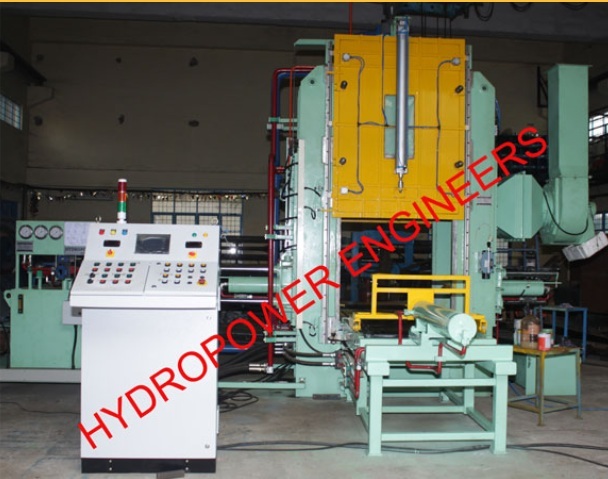 | Hydraulic Presses Compactor The Compactor is a specialized H-type hydraulic press designed to compress drums to one-fifth of their original size. |
Frequently asked questions
What should an industrial hydraulic compactor specification sheet include?
Request ram force, chamber volume, feed opening, compressed output weight, cycle time, complete-cycle throughput, power requirements, dimensions, safety controls and test conditions.
How do you calculate hydraulic compactor capacity?
Use your measured waste volume, bulk density, feed frequency and target compression ratio to calculate load weight per cycle and required hourly throughput.
Which Bangalore operating conditions affect compactor selection?
Check available electrical supply, floor loading, access for delivery, drainage, dust, monsoon exposure, ventilation, operator space and maintenance access before installation.
How do you verify a hydraulic compactor before approving purchase?
Run a witnessed test using your waste, record cycle time and output weight, inspect bale or container dimensions, and compare results with the signed specification.