A jack’s tonne rating alone cannot tell you whether it is suitable for a press, rolling machine, structural assembly, or maintenance lift. You will be able to calculate the required load, compare dimensions and control features, select the correct jack type, and write a procurement specification that addresses stability, inspection, support, and Bangalore-area service conditions.
Key takeaways
- Convert each metric tonne to 9.80665 kN before selecting jack capacity.
- Specify rated capacity, minimum height, stroke, saddle size, and hydraulic pressure.
- Use lock-nut jacks when the load must remain mechanically supported.
- State load distribution, lifting points, inspection records, and test requirements in writing.
How to calculate capacity, working load, and safety margin
Begin with the lifted mass: convert metric tonnes to force using 1 metric tonne-force = 9.80665 kN. Then map the centre of gravity, lifting points, load distribution, and any movement during the lift.
These facts determine hydraulic jack load requirements; total mass divided by the number of jacks is unsafe unless a demonstrated load-sharing arrangement exists.
- Calculate the nominal force at each lifting point, then increase it for unequal floor stiffness, guide friction, centre-of-gravity movement, and different leakage rates between jacks.
- State the expected working load per jack, total lifted load, maximum permitted load imbalance, and whether the lift is static, rolling, inclined, or synchronized.
- For first-order sizing, use force = pressure × effective piston area. At 700 bar, producing 100 metric tonnes-force requires about 140 cm² of effective piston area before friction, pressure losses, and rating limits.
- Apply a stated engineering margin so the planned working load remains below the jack’s marked rated capacity. The rating is a maximum limit, not a target.
- Treat proof load separately: its record documents test performance and does not increase the permitted operating load.
An overload valve limits hydraulic pressure; it does not correct a bad load calculation, unequal sharing, or unstable contact. For synchronized lifting, specify position monitoring or a defined equalisation procedure and a maximum permitted height difference between lifting points.
Which dimensions and hydraulic ratings determine suitability
A jack with enough capacity is unusable if its collapsed height exceeds the available gap. Specify minimum collapsed height, usable stroke, maximum extended height, saddle or attachment height, and mechanical extension as separate dimensions; stroke alone does not describe reach.
Pressure changes the entire system, not just the pump. Two jacks rated for the same load can require different equipment when one operates at 350 bar and another at 700 bar.
| Pressure | Component consequence | Required check |
|---|---|---|
| 350 bar | Lower-rated pump, hose, couplers, valves, and fittings | Confirm every component exceeds working pressure |
| 700 bar | Higher-pressure pump and connections | Confirm pressure rating, proof record, and compatibility throughout |
Include saddle diameter or dimensions, base area, contact pressure, allowable eccentricity, permitted side load, jack weight, lifting speed, controlled lowering speed, and oil volume. Request the rated capacity of every hose, coupler, valve, and fitting, not a generic “safety valve.”
Specify a load-holding valve, overload protection, and hose-burst protection where applicable. Single-acting jacks need a defined return system; double-acting circuits power both extension and retraction but add hoses, valves, pump capacity, and contamination risks.
State the hydraulic-fluid type, filtration or cleanliness requirement, seal material, and acceptable operating-temperature range. Contamination can cause valve leakage and loss of load holding; incompatible fluid can damage seals.
Ask for dimensional drawings, pressure ratings, test or proof records, and a complete oil-volume and pump-compatibility statement. These details make heavy duty hydraulic jack specifications usable for procurement and installation.
Choosing between bottle, toe, machinery, low-height, lock-nut, and double-acting jacks
Your hydraulic jack load requirements determine the architecture: access height, load path, movement, and how long the load must remain supported. Check heavy duty hydraulic jack specifications for axial loading, allowable eccentricity, operating pressure, and attachment dimensions—not capacity alone.
| Option | Best fit | Wrong choice |
|---|---|---|
| Bottle jack | High-capacity lifting from a stable, vertical base with adequate clearance | Very low entry points, side loading, or loads that cannot stay centred |
| Toe jack | Inserting beneath machinery through a small floor gap | Using the toe instead of a broad, stable load-transfer attachment |
| Machinery jack | Moving or positioning heavy equipment with a suitable lifting point | Rolling machinery without wheel control or restraint |
| Low-height jack | Restricted-clearance lifting | Any lift requiring more stroke than its compact body provides |
| Lock-nut jack | Mechanical support during a prolonged task | Assuming the lock nut makes an unstable lift safe |
| Double-acting jack | Powered extension and retraction, synchronized lifting, or controlled positioning | Sites unable to maintain clean hoses, valves, pumps, and hydraulic oil |
For synchronized lifting, use a suitable power unit, position monitoring, a defined operator equalization procedure, and a stated maximum permitted height difference between lifting points. Independent manual pumps are unsuitable when differential movement could damage the load.
A jack is the wrong tool when the load has no designated lifting point, is inclined or eccentric without engineered restraint, or needs permanent support. Transfer permanent loads to rated stands, cribbing, mechanical locks, or maintenance supports.
Managing unstable loads, inspection risks, and safe lifting practice
Use a jack only on a level, adequately strong base, with axial force passing through the manufacturer-designated saddle. Uneven floors, inclined or eccentric loads, side loading, rolling machinery, and shifting loads can bend the plunger, slip the saddle, or overturn the load; higher capacity does not correct poor contact.
- Isolate energy sources, shut down and lock out the equipment, remove stored hydraulic, pneumatic, electrical, and mechanical pressure, and secure moving parts.
- Chock wheels and apply restraints to rolling machinery or loads that can move.
- Confirm the manufacturer-designated lifting point and fit cribbing or a load-transfer plate when the manufacturer or lift plan requires it.
- Establish an exclusion zone and keep every worker clear of the suspended load.
- Lift gradually, stopping to check saddle contact, base stability, load movement, and hydraulic leakage.
- Lower the load in a controlled manner and complete a stability check before anyone enters beneath the equipment.
- Transfer the load to rated stands, cribbing, mechanical locks, or maintenance supports before entry; a jack is not long-term support.
Before use, inspect for oil leaks, damaged hoses or fittings, cracked welds, bent plungers, worn seals, unstable bases, damaged couplers, and illegible capacity markings. Record periodic inspections, lubrication, and maintenance; tag defective equipment and remove failed jacks from service. These controls belong in the hydraulic jack load requirements, not as an afterthought.
What to put in a Bangalore Division purchase specification
Write hydraulic jack specifications in bangalore division as measurable tender fields, not as “heavy duty.” Compare each hydraulic jack manufacturer bangalore option against the planned load, dimensions, controls, environment, and service evidence.
- State rated load in tonnes-force or kilonewtons, planned working load per jack, operating pressure, and proof-load documentation. Record minimum height, maximum height, stroke, saddle and base dimensions, allowable eccentricity or side load, mass, lifting speed, and controlled lowering speed.
- Specify oil volume, permitted fluid, seal material, operating-temperature range, filtration or cleanliness target, overload protection, load-holding valve, hose-burst protection, and coupler standard. Require inspection interval and maintenance procedure.
- For outdoor or monsoon-exposed use, require corrosion protection, protected couplers, wiper seals, water-resistant storage, and a local inspection and repair route.
- Request a dimensional drawing, operating manual, spare-seal list, serial-numbered test record, capacity-marking photograph, and written service-response terms.
| Requirement | Acceptable evidence | Reject or clarify |
|---|---|---|
| Capacity and safety | Rated limit, working load, pressure, and proof record shown separately | “Heavy duty” without figures |
| Hydraulic circuit | Component pressure ratings, fluid and seal compatibility, cleanliness target | Generic “safety valve” only |
| Support | Inspection interval, defect-removal process, repair contact, response time | Factory certificate with no service route |
Hydropower Engineers can be considered for a customized hydraulic system, synchronized lifting arrangement, or industrial lifting equipment rather than an off-the-shelf jack; compare its documented technical fit and support plan with other suppliers. These heavy duty hydraulic jack specifications matter more than location.
Related product
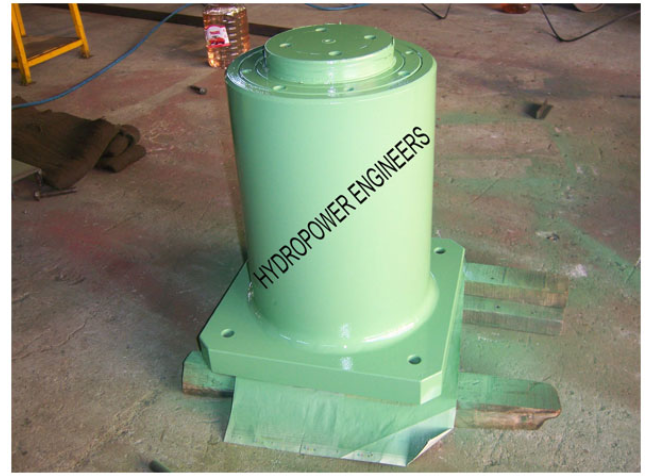 | Hydraulic Lift Hydropower Engineering Systems offers durable and high-performance Hydraulic Jacks designed for lifting heavy loads with ease and precision. View product → |
Frequently asked questions
How do you calculate industrial hydraulic jack capacity?
Convert mass to force using 1 metric tonne-force = 9.80665 kN, then account for load distribution, centre of gravity, movement, and safety margin.
Which hydraulic jack dimensions and ratings matter most?
Check rated capacity, minimum and maximum height, stroke, saddle or toe dimensions, working pressure, return method, stability, and available clearance.
Which type of hydraulic jack suits a heavy industrial lift?
Choose bottle, toe, machinery, low-height, lock-nut, or double-acting designs according to clearance, access, holding requirements, alignment, and return control.
How can you manage unstable loads during hydraulic lifting?
Map the centre of gravity, use rated lifting points, lift in controlled stages, prevent lateral movement, block the load, and never rely on hydraulic pressure alone.
What belongs in a Bangalore Division hydraulic jack purchase specification?
State capacity in tonnes and kilonewtons, dimensions, stroke, pressure, materials, safety features, inspection documents, testing, operating conditions, and service requirements.