A retrofit or annual maintenance contract is worthwhile only when the machine’s frame, forming head, hydraulics, tooling and controls can support the required production range. By checking those limits first, you can decide whether to repair, modify, retrofit, overhaul or replace the equipment—and define an AMC scope that protects uptime instead of buying a vague maintenance promise.
Key takeaways
- Check frame, forming head, hydraulics and tooling against required tube specifications.
- Repair hydraulic faults before placing the machine under routine AMC.
- Choose modifications over replacement when the machine’s structure meets production requirements.
- Prove retrofit performance with documented force, stroke, range and production tests.
How to Decide Whether Your Pipe Swaging Machine Is a Retrofit Candidate
A retrofit is justified only when the frame, forming head, hydraulics, and tooling can deliver the required tube range without exceeding their original limits. New controls cannot create extra swaging force, stroke, diameter capacity, wall-thickness capability, or production rate.
1. Record the machine’s age, maximum pipe or rod diameter, available stroke, material grades, wall thicknesses, reduction per pass, target cycle time, and present defect rate. Compare these figures with the output you need after the project.
2. Inspect the frame for cracks, permanent distortion, loose joints, and damaged die seats. Measure spindle or carriage runout, die alignment, guide wear, chuck condition, and forming-head movement. A worn structure will transfer errors into every component, even after installing a new PLC.
3. Test hydraulic pressure and flow during the forming stroke, relief-valve setting, cylinder leakage, pump efficiency, oil cleanliness, filtration, hose condition, pressure stability, and heat buildup over repeated cycles. A replacement pump or seal is repair; it does not cure contamination, misalignment, scored cylinder surfaces, or a faulty relief valve.
4. Check the electrical panel, obsolete drives, sensors, HMI, control backups, guarding, vibration, noise, and actual cycle sequence. This evidence separates swaging machine retrofitting from overhaul, modification, or replacement.
Choose retrofitting when the measured structure and process capacity already cover the required job. If the frame is cracked, the forming head is unrepairable, die seats cannot be corrected, or the required tube range exceeds capacity, replacement is safer. Modifications, repair, and AMC servicing create value only when they support a sound machine.
Inspect the Frame, Tooling and Controls Before Approving Any Work
Measure the machine before you approve pipe swaging machine repair, retrofit or replacement. Record frame cracks, permanent deformation, die alignment, spindle and carriage runout, slide and guide wear, chuck condition, die-holder wear, available stroke and the largest tube or rod diameter processed. Photograph each reading and identify the instrument used.
- Test hydraulic pressure and pump flow at idle and during the forming stroke; record relief-valve pressure, pressure stability, cylinder leakage, oil temperature after repeated cycles, oil level, contamination, filter condition, hose damage and valve response.
- Record actual cycle time, vibration, abnormal noise, heat buildup, dimensional variation, defect rate and tooling changeover time across a representative production run.
- Inspect the electrical panel for heat damage, loose terminals, obsolete drives, failed cooling, damaged wiring and missing schematics. Back up the PLC program, HMI recipes, alarm history and parameter files before changing controls.
- Verify guarding, interlocks, emergency stops, isolators and protection against unexpected start. A changed PLC program is not safety validation; document the risk assessment and functional tests after any change to tooling, speed, stroke, loading or control logic.
| Action | Evidence to document | Use it when |
|---|---|---|
| Repair | Failed seal, hose, sensor or valve; root cause identified | One component is defective |
| Retrofit | New PLC, HMI, drive, valve or sensor with existing structure sound | Controls limit performance |
| Overhaul | Measured wear across hydraulics, guides and tooling | Several systems need restoration |
| Replacement | Cracked frame, inadequate stroke or forming capacity | Structural limits defeat the business case |
A replacement pump or seal is not a complete repair if contamination, misalignment or scored cylinder surfaces remain.
Which Hydraulic Faults Need Repair Rather Than Routine AMC
Treat a defect as production-critical when it threatens operator safety, uncontrolled movement, hydraulic stability, or finished-part conformity; routine maintenance addresses predictable deterioration before those failures occur.
| Condition | Repair now | Routine AMC action |
|---|---|---|
| Hydraulic circuit | Pressure fluctuates during the forming stroke, the relief valve cannot hold its set pressure, or a cylinder drifts under load | Record pressure, pump flow, oil temperature, and cylinder leakage against baseline |
| Mechanical system | Cracked guarding, severe die wear, misaligned tooling, excessive runout, or damaged guides produces ovality, wall-thickness variation, or tool marks | Measure die condition, alignment, vibration, and noise, then lubricate and adjust within specification |
| Appearance and minor wear | Paint loss, a dented enclosure, or a loose label with no safety or process effect | Clean, touch up, tighten, and schedule the work without delaying critical repairs |
For pipe swaging machine repair, do not replace a seal, hose, or pump until you identify why it failed. Check rod wear, scored cylinder surfaces, blocked filtration, oil level and cleanliness, hose damage, pump efficiency, and relief-valve operation. A new seal will fail again if misalignment or contamination remains.
Use swaging machine AMC service as a condition record, not a calendar visit. Compare flow, pressure stability, repeated-cycle heat buildup, cycle time, electrical-current trend, finished-part dimensions, and leakage with the original baseline. Escalate any worsening trend before it becomes a rejected-batch or safety event. Paint deterioration should never consume the budget assigned to those faults.
When Do Swaging Machine Modifications Beat Buying a New Machine?
A retrofit is the better investment when the frame, forming head and die seats remain sound, but obsolete controls or motion hardware limit output. Swaging machine modifications can add a servo feed, proportional-hydraulic control, variable-frequency drive, sensors or a modern PLC to improve positioning, acceleration and recipe repeatability.
Specify controlled acceleration and deceleration; a faster pump or motor can increase shock loading on dies, slides, bearings and the frame.
| Option | Decision signal | Likely outcome |
|---|---|---|
| Repair or overhaul | The frame and forming geometry are sound, while seals, hoses, valves, bearings or contaminated oil cause faults | Restore reliability without changing capacity |
| Swaging machine retrofitting | Mechanical wear is within correction limits, but controls, drives, sensors or the electrical panel restrict repeatability or serviceability | Extend useful life and improve measurable performance |
| Replacement | Cracks, permanent distortion, uncorrectable die-seat wear or an obsolete, unrepairable cylinder or spindle remain | Reduce structural and lifecycle risk |
Choose retrofitting only after recording hydraulic pressure and flow, cylinder leakage, die alignment, spindle or carriage runout, guarding, cycle time and defect rate. Compare those results with the required tube diameter, wall thickness, material hardness, reduction per pass and production rate.
If the required range exceeds the frame, actuator, stroke, tooling or hydraulic capacity, new controls will not create that capacity. Replacement is safer when the machine cannot hold alignment or pressure stability through repeated forming cycles.
How to Write an AMC Scope and Prove the Retrofit Works
A retrofit earns approval only when its promised gain has a number, a test method and an acceptance limit. “Modernize the machine” is not a specification.
1. Create a baseline before work starts. Record hydraulic pressure and flow, cycle time, oil temperature, leakage, vibration, noise, motor current, die condition, alignment and finished-part dimensions across representative tube sizes and materials.
2. Write the AMC contract around condition, not visits. A swaging machine amc service should require trend records, relief-valve testing, cylinder leakage checks, filtration and oil-cleanliness checks, hose inspection, die measurement and heat buildup during repeated cycles. Define response times for production-critical failures. Keep paint and minor enclosure damage separate from pipe swaging machine repair.
3. State the retrofit outcome in figures. Specify the supported material grade, diameter and wall-thickness range, reduction per pass, cycle-time range, dimensional repeatability, pressure stability, alarm response time and tooling changeover time. Identify which modifications, controls and amc servicing tasks create each benefit.
4. Require safety verification after pipe swaging machine retrofitting. A documented risk assessment must cover guarding, interlocks, emergency stops, safe isolation and unexpected-start prevention; a PLC change alone proves none of these.
5. Commission with production tooling and representative material, not an unloaded dry cycle. Sign acceptance only after leak-free operation, stable pressure, agreed cycle time, repeatable dimensions and correct alarm, interlock and emergency-stop behaviour. Hydropower Engineers can use this evidence-based format when separating retrofit scope from modifications, repair and replacement decisions.
Related product
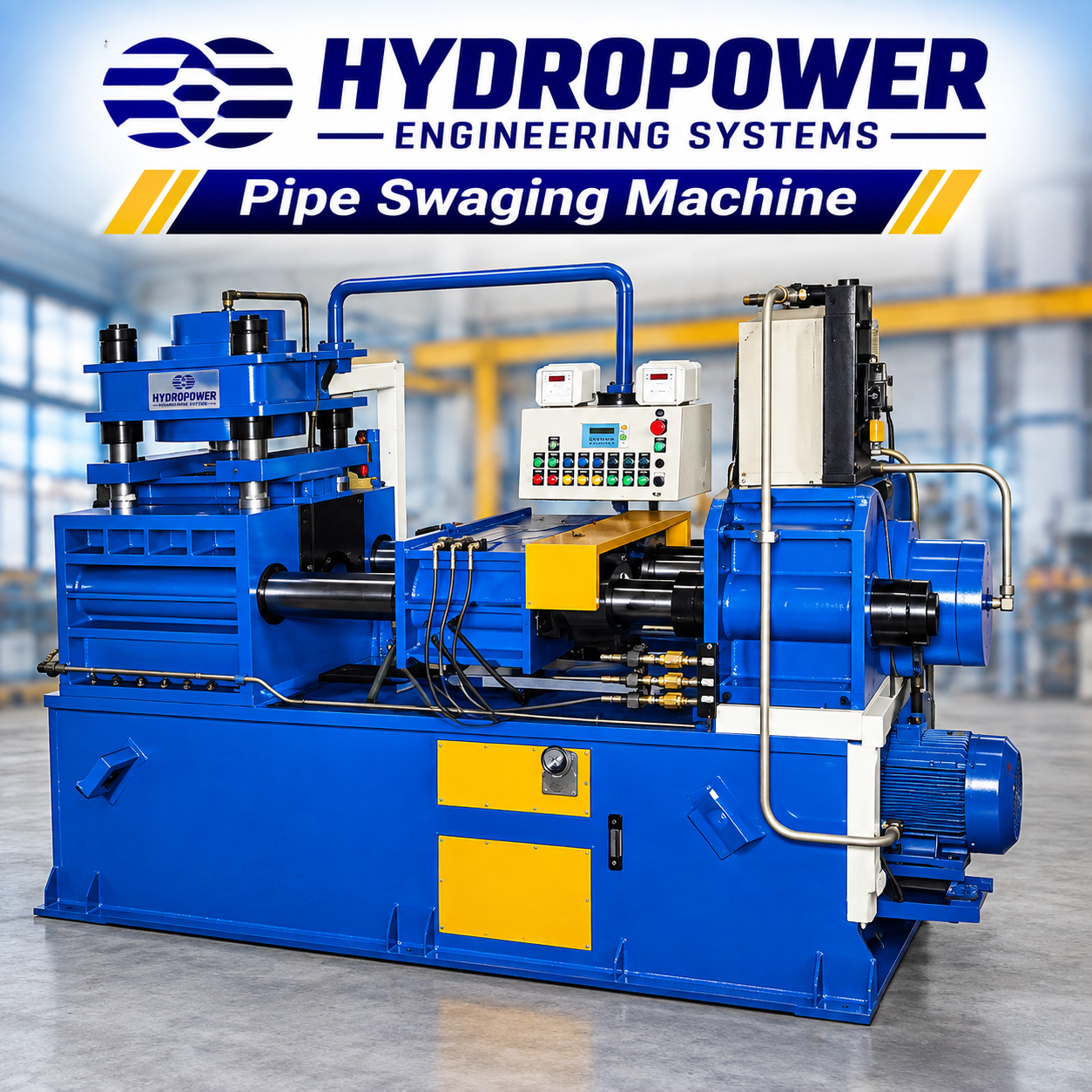 | Pipe Swaging Machine Hydropower Engineering Systems manufactures robust and efficient Pipe Swaging Machines designed to reduce the diameter of pipes and solid rods to the... View product → |
Frequently asked questions
How do you decide whether a pipe swaging machine is a retrofit candidate?
Confirm that the frame, forming head, hydraulics and tooling can handle the required tube range within their original limits.
What should you inspect before approving swaging machine modifications?
Inspect the frame, forming head, tooling, hydraulic circuit and control system for wear, damage and capacity limits.
Which hydraulic faults require pipe swaging machine repair instead of routine AMC?
Repair faults that affect pressure, flow, leakage, motion control or forming force before treating the machine as an AMC-maintenance task.
When do swaging machine modifications beat buying a new machine?
Modifications make more sense when the existing structure meets the required capacity and the upgrade costs less disruption than replacement.