Stainless steel rewards accurate pressing but exposes poor choices through burrs, galling, springback, frame deflection and distorted tube ends. By the end, you will be able to match a C-frame press to a fabrication operation, check whether its working envelope and tooling are adequate, and compare it with alternative press types.
Key takeaways
- Use the open throat for accessible loading, but check frame deflection and throat depth.
- Calculate force from material, thickness, cut length and operation—not the press tonnage label.
- Specify stroke, daylight, bolster, controls and safety features for the actual stainless job.
- Choose a straight-side press when deep draws, high accuracy or heavy off-centre loads dominate.
The open C-shaped frame is useful—and its geometry sets limits
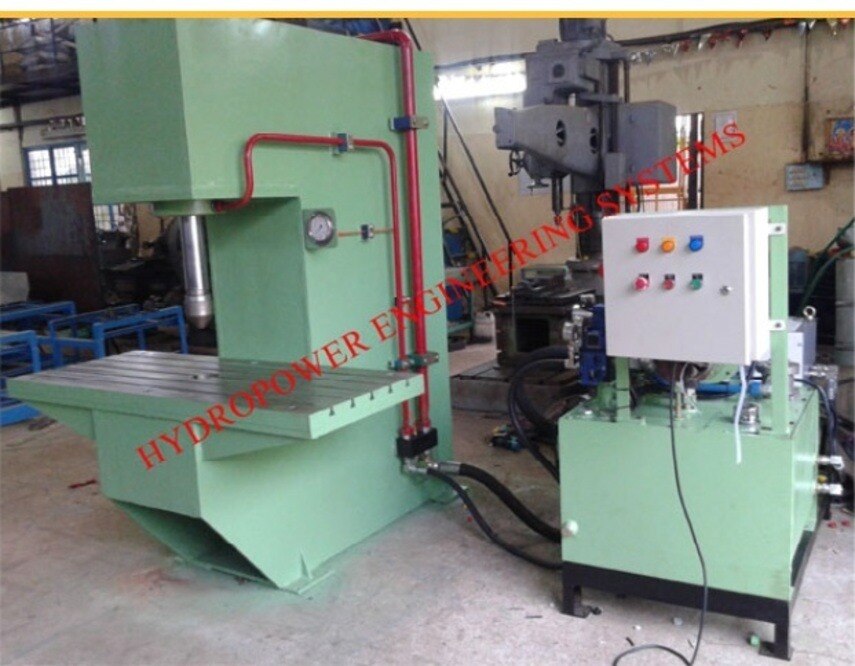
A C-frame press is a hydraulic press whose side frame forms a C when viewed from the front. The frame supports a hydraulic cylinder and ram above a bolster or bed, where you mount the die; the open throat creates a working envelope accessible from the front and sides.
That access matters when you load stainless blanks, welded assemblies, brackets, or tube sections. You can see the tooling, position irregular parts without feeding them through a closed frame, and remove finished pieces quickly. These are the practical advantages behind many C frame press applications, especially low- to medium-volume fabrication.
- Punching and piercing holes in stainless sheet or brackets
- Blanking small profiles from prepared sheet
- Embossing logos, ribs, beads, or identification marks
- Bending brackets and shallow forming parts
- Flattening welded sections or tube ends
- Straightening components after forming or welding
- Swaging, end forming, and press-fitting inserts
The same opening creates the main limitation: a C-frame is less resistant to spreading and angular deflection than a four-column or straight-side press. Off-centre loading can tilt the ram, misalign the die, mark the stainless surface, or produce uneven dimensions; excessive force can permanently distort the frame.
Keep the load centred, use guided tooling, and verify alignment under load rather than judging the machine by nominal tonnage alone.
How stainless parts move from blank to finished component
A C-frame hydraulic press processes stainless steel by driving a guided ram and die into a prepared blank, then releasing it for inspection and unloading. The hydraulic circuit controls approach, pressing force, dwell, return and decompression; those stages matter because stainless steel can spring back, gall against tooling and harden at the worked area.
- Cut the sheet or tube blank to size, remove burrs, and mark its orientation. Confirm the grade, thickness or tube diameter before setting the job.
- Install the punch, die, guides and backstops on the bolster. Align them without forcing the ram, then check clearance and lubrication for stainless contact surfaces.
- Load the blank against the stops and run a slow approach. Apply force through the working stroke; use a pressure hold when seating, embossing or pressing a component into place.
- Retract with controlled decompression, remove the part, and inspect hole position, edge tearing, bend angle, surface marks, springback and tube ovality.
| Operation | What the press does | Suitable use |
|---|---|---|
| Punching or blanking | Shears material between punch and die | Holes, slots and small profiles in sheet |
| Embossing or shallow forming | Pushes the blank into a shaped cavity | Logos, ribs, steps and shallow trays |
| Bending, flattening or straightening | Applies force against a form or flat tool | Brackets, welded distortion and formed sections |
| Tube end forming, swaging or assembly | Compresses or expands a controlled zone | Reduced ends, collars, bushings and press fits |
A C-frame hydraulic press is not automatically a deep-drawing machine because its cylinder carries a high nominal tonnage. Deep draws and large-area forming need suitable draw depth, blank holding, guidance and an adequately supported die.
Choose force from the operation, not the tonnage label
A 20-ton label does not tell you whether a press will punch a 2 mm 304 sheet or flatten a welded tube. Calculate force from the operation, stainless grade, thickness, cut perimeter or forming area, and the required safety margin.
For punching, estimate shear force from cut perimeter × thickness × material shear strength, then allow for stripping and tool friction.
Select tooling that controls the work rather than relying on ram force alone. Use a guided punch-and-die set for piercing, generous forming radii for work-hardening 304 or 316, suitable die clearance, and lubricant that will not contaminate the finished surface.
Avoid repeated partial hits, redraws and rubbing passes; they harden the stainless and make later piercing more difficult.
Check these machine dimensions before approving the press:
- Daylight and die height: fit the closed tool, component and loading method with adjustment range remaining.
- Stroke: cover the full forming depth, punch entry and safe return.
- Throat depth: reach the feature without the part contacting the frame.
- Bed and ram size: support the die plates and component without overhang.
- Off-centre load rating: prevent ram tilt and frame deflection.
- Approach, working, return, dwell and decompression controls: match forming, seating and release.
| Operation | Capacity driver | Tooling and dimension priority |
|---|---|---|
| Punching | Perimeter, thickness and shear strength | Guided die, clearance, throat reach |
| Bending | Material flow and bend length | Radius, die opening and stroke |
| Flattening | Contact area and tube stiffness | Parallel platens, daylight and guidance |
| Assembly | Interference and seating force | Controlled dwell, alignment and decompression |
A Bangalore buying specification must describe the actual job
Specify the job in numbers, not as a “C-frame press for stainless steel fabrications in Bangalore Division.” State the stainless grade, sheet thickness or tube diameter and wall, operation, part dimensions, required force, tolerance, cycle rate, and batch size.
A press for 2 mm 304 punching is not the same purchase as one for flattening 38 mm stainless tube.
Give the supplier this checklist:
- Operation and tooling: punching, bending, tube end forming, straightening or assembly; include die height, die opening, guide arrangement and replaceable wear parts.
- Machine envelope: bed and ram dimensions, throat depth, daylight, stroke, approach and pressing speeds, dwell time, and working height.
- Load control: calculated force, pressure gauge accuracy, programmable bottom position, repeatability, allowable off-centre load and ram parallelism.
- Tube work: mandrel provision, tube support, end-location stop and guides; unsupported pressing can cause ovality, buckling or galling.
- Site and safety: 415 V, three-phase, 50 Hz supply, motor rating, guarding, two-hand control or interlocked protection, emergency stop and noise provisions.
- Compliance and service: Karnataka Factories Rules, 1969, applicable provisions of the Factories Act, 1948, installation responsibility, spare seals, response time and operator training.
Before acceptance, run parts in the specified grade and thickness. Record force or pressure, bottom-position repeatability, alignment under load, springback, leakage, surface galling and tube ovality; an unloaded stroke test proves little. Hydropower Engineers should receive these trial-part and site requirements before proposing a build.
Related product
 | Hydraulic Presses We are a leading and well-recognized manufacturer of C-Frame Hydraulic Presses, widely used in applications such as embossing, punching, piercing,... View product → |
When another press configuration is the better fit
Choose an H-frame, turret punch or press brake when the part’s size, speed or geometry exceeds a C-frame’s useful envelope. A C-frame hydraulic press suits centrally loaded punching, bending, flattening and assembly work, but off-centre stainless loads can twist the ram and open the frame.
| Option | What it means | When it applies |
|---|---|---|
| C-frame hydraulic press | Open front, adjustable stroke and force, with convenient loading and visibility | Small or medium parts, tube work, shallow forming and varied low-to-medium volume jobs |
| H-frame hydraulic press | Stiffer, more supported structure with a larger bed and better load distribution | Deep drawing, large-area forming, heavy straightening or dies that place force away from centre |
| Mechanical power press | Fast crank-driven cycles with a fixed stroke and dedicated die | High-volume repetitive blanking or piercing where cycle speed matters more than flexibility |
| Turret punch | CNC tool station indexes among punches for programmed sheet patterns | Many hole sizes, repeated layouts and sheet nesting; not a substitute for tube forming or press-brake bends |
| Press brake | Long beam and punch-die tooling create controlled linear bends | Cabinets, channels and long stainless panels requiring accurate bend angles |
A turret punch wins on hole variety; a press brake wins on long bends. The C-frame wins when one machine must handle several shorter operations, provided the die remains aligned under load.
Do not buy from the label “stainless steel fabrication press in Bangalore division.” Specify grade, thickness or tube size, operation, force, tolerance and production rate, then trial the actual material for burrs, springback, galling and distortion.
Frequently asked questions
What is a C-frame press?
A C-frame press is a hydraulic press with a C-shaped side frame, overhead cylinder and ram, and a die mounted on the bolster or bed. Its open throat provides front and side access.
What are C-frame press applications in stainless steel fabrication?
Applications include bending, forming, punching, blanking, embossing, flanging and assembly work when the component fits the throat and the frame can handle the load.
How do you choose force for a stainless steel fabrication press?
Choose force from the operation, stainless grade, thickness, cut length or contact area, tooling and required safety margin. Do not select equipment from the tonnage label alone.
What should a Bangalore Division buying specification include?
Describe the stainless grade and thickness, operation, part dimensions, tooling, required force, stroke, daylight, throat depth, bolster size, production rate, controls, guarding, electrical supply and installation conditions.
When is another press configuration better than a C-frame press?
Choose a straight-side or four-column press when deep drawing, close parallelism, high repeatability, large tooling or sustained off-centre loading exceeds the C-frame's working limits.