Availability depends on the exact cylinder configuration, not merely on whether a supplier lists telescopic cylinders. By checking stage dimensions, hydraulic requirements, manufacturing status, dispatch conditions, and test documentation, you can distinguish an ex-stock replacement from a made-to-order assembly and plan procurement without delaying equipment production.
Key takeaways
- Ask for a written dispatch date from a named Bangalore location.
- Match bore, stroke, collapsed length, load, pressure, and mounting points.
- Inspect every stage, weld, seal, port, and test record before acceptance.
- Choose telescopic cylinders when long stroke must fit limited installation space.
What “available” means for a Bangalore heavy-equipment buyer
A cylinder is not genuinely available for dispatch until the complete, tested assembly matches your machine. Telescopic cylinder availability in Bangalore Division is a configuration-and-lead-time question, not proof that a catalogue model exists. Request a written dispatch date from a named Bangalore location.
Ask the supplier to confirm:
- Number of stages, bore and rod diameters, stroke, collapsed length, mounting geometry, operating pressure, and port arrangement.
- Whether the unit is ex-stock, semi-finished stock needing machining, or engineered to order.
- Whether the required tubes, chrome-plated rods, seals, mounting parts, and cushions are already allocated to your order.
- Which work is performed in-house and which is subcontracted, especially honing, rod plating, seal supply, and multi-stage assembly.
- The final inspection and pressure-test date, packing date, transport method, and delivery constraints to your site.
- Local support for installation, commissioning, repair, and replacement rather than dispatch-only supply.
A tube or cylinder body on a shelf does not establish hydraulic cylinder sourcing. Missing seals, machining capacity, or a final test slot can add more time than fabrication.
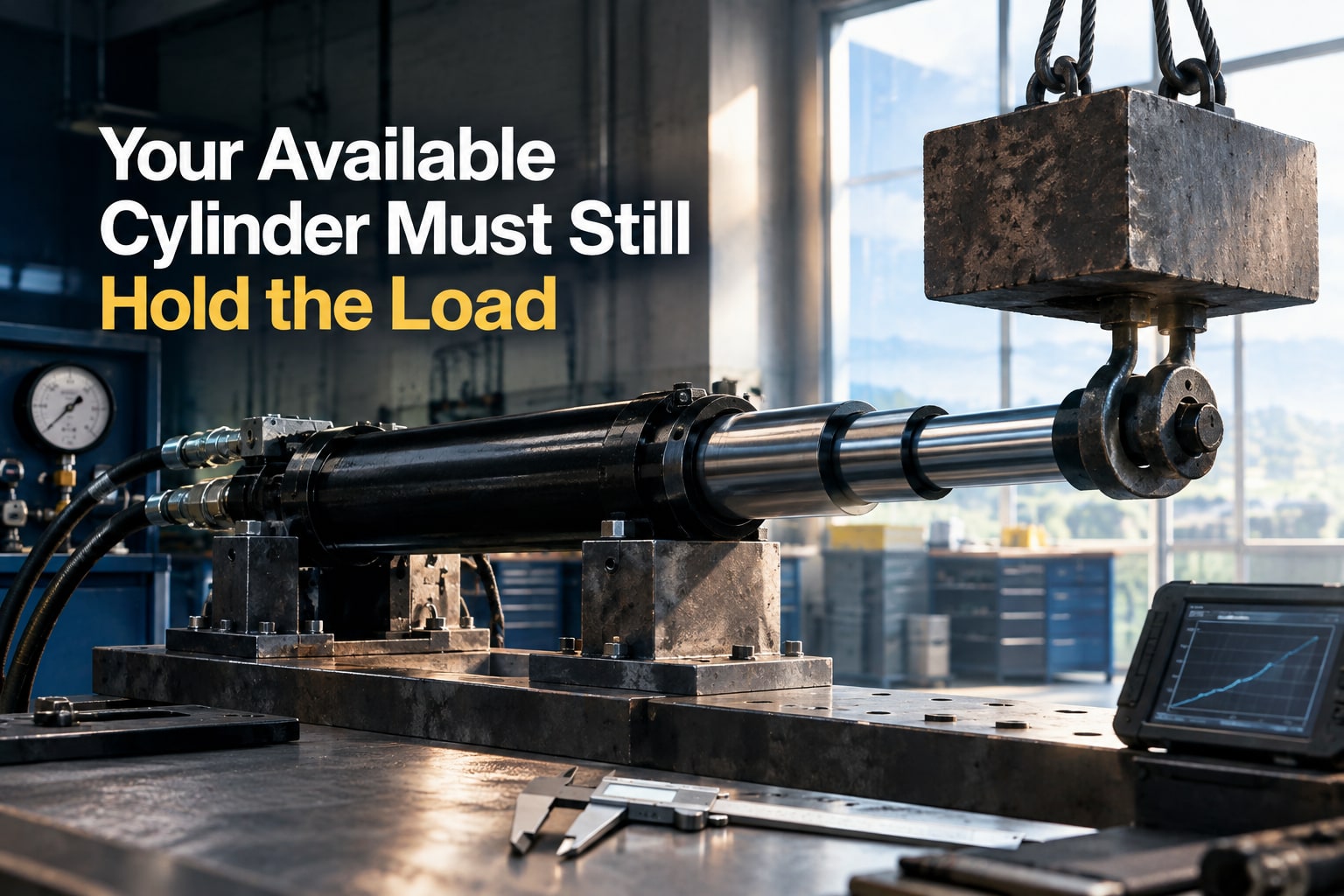
For a replacement, compare more than mounting dimensions. Confirm hydraulic flow, extension and retraction time, stage sequence, closed-length behavior, end-of-stroke cushioning, load-holding provisions, articulation, and relief or counterbalance-valve settings. Request the complete-cylinder working-pressure rating and proof-test basis; the weakest stage, joint, seal system, or stability calculation governs safe use.
How the stages extend, retract, and hold a load
Inside a telescopic cylinder, nested barrels or sleeves extend one at a time as pressurised oil reaches each annular piston area. The first stage travels to its internal stop; oil routing and bore-area relationships then bring the next stage into motion. Seals contain pressure, guides limit uneven contact, and cushions slow the final movement.
Do not infer this order from appearance: confirm it in the hydraulic schematic and test procedure.
| Stage behaviour | What happens | Controls to verify |
|---|---|---|
| Extension | Oil enters the extension port and stages move in the designed sequence | Flow control, internal stops, sequence valve or staged oil routing |
| Retraction | Oil is routed to the opposite side; stages return in the specified order | Counterbalance valve, return flow control, pilot pressure and minimum load |
| Load holding | Pressure is trapped while the directional valve is neutral | Pilot-operated check valve or counterbalance valve, plus relief protection |
| End of stroke | Cushioning restricts oil near full travel | Cushion nose, adjustable needle, pressure limit and abnormal-noise check |
A counterbalance valve prevents a suspended load from overrunning the pump and helps stop sudden collapse if a hose fails. A relief valve protects the circuit from pressure spikes; neither device replaces correct stage sequencing.
Retraction needs separate proof: gravity may return a vertical cylinder but fail with horizontal mounting, changing load direction, or insufficient external force. Ask the multi stage hydraulic cylinder manufacturer to test both directions at representative flow, pressure and load, recording leakage, stick-slip, stage order and end-of-stroke behaviour.
The dimensions and forces that determine the right cylinder
A safe size starts with geometry and load path, not bore alone. Provide retracted length, minimum and maximum extended lengths, available space, mounting centres, pin diameters, articulation angles, and the external guidance arrangement.
- State the lifted or pushed load, its centre of gravity, force direction, tipping risk, shock loading, duty cycle, and required extension and retraction times.
- Give working pressure, relief-valve setting, counterbalance-valve setting, pump flow, port size, oil type, and operating temperature.
- Identify side loads, bending moments, off-centre loading, and whether the cylinder carries the load or only positions it.
- Calculate buckling for the rod and every stage. The smallest stage at full extension is often the critical member; inadequate guidance can cause bending or excessive deflection despite sufficient theoretical force.
- Confirm end-of-stroke behavior, cushions, stage sequence, load-holding provisions, and whether the replacement must match the machine’s existing hydraulic circuit.
| Input | Why it changes the design | Failure if omitted |
|---|---|---|
| Stroke and closed length | Sets stage count, overlap, and package size | The cylinder cannot fit or reach the required position |
| Load and side load | Determines bore, wall thickness, guidance, and buckling margin | Rod or stage instability, bending, or seal damage |
| Flow and pressure | Sets speed, porting, tube stress, and valve compatibility | Slow movement, pressure loss, or uncontrolled descent |
| Mounting and sequence | Controls articulation, stop positions, and stage behavior | Pin binding, uneven extension, or wrong retraction order |
A custom telescopic cylinder needs these figures alongside the machine drawing and hydraulic schematic; catalogue dimensions alone do not establish safe interchangeability.
When a telescopic cylinder is better than the alternatives
Choose a telescopic cylinder when the required stroke will not fit inside the machine’s retracted envelope. Its advantage is packaging, not automatically higher force or lower cost. Compare the alternatives against collapsed length, guidance, control, maintenance, and load stability.
| Option | Main advantage | Main drawback | Choose it when |
|---|---|---|---|
| Telescopic cylinder | Long stroke from short retracted length | More stages add seals, sliding surfaces, guides, and leakage paths | Space is tight and hydraulic positioning matters |
| Single-stage cylinder | Simpler sealing, guidance, inspection, and repair | Requires a retracted length close to its full stroke | The machine has enough room for a conventional barrel and rod |
| Fewer-stage design | Reduces complexity while retaining some packaging benefit | Needs more installation length than a higher-stage cylinder | You can enlarge the envelope to improve durability and service access |
| Mechanical extension | No hydraulic seals or pressure circuit for the extension | Adds linkage, screw, rack, or sliding hardware and may reduce speed or load flexibility | Extension is infrequent and the mechanism can be protected |
| Winch and cable | Long reach with flexible routing | Cable stretch, drum space, reeving, exposed wear, and less rigid load control | The load path is flexible and precise guided movement is unnecessary |
Do not compare stroke alone. Check side-load exposure, duty cycle, extension speed, retraction time, pressure, and the stability of every stage under load. A two-stage cylinder can be the better choice than a four-stage unit if its collapsed length fits.
For telescopic cylinder availability in Bangalore Division, ask whether the quoted configuration is ex-stock, semi-finished, or engineered to order. When reviewing Hydropower Engineers, request confirmation of stage dimensions, seals, mounting parts, complete-cylinder proof testing, and the actual dispatch date.
Related product
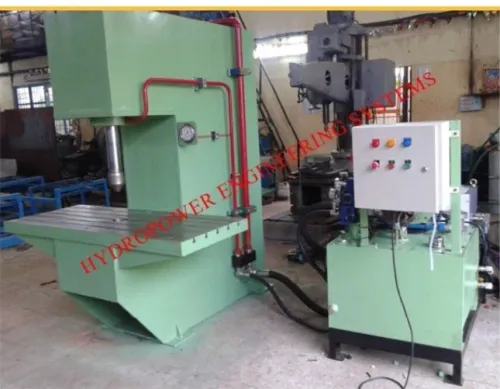
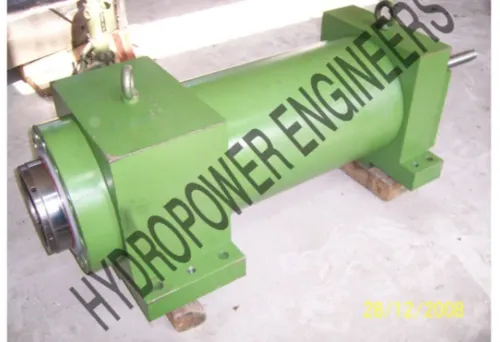
 | Hydraulic Cylinders Hydropower Engineering Systems offers high-performance Telescopic Cylinders, also known as multistage hydraulic cylinders, designed for applications... View product → |
How to specify, inspect, and accept the cylinder
Put the requirements on the purchase order, not in a later discussion.
State working and proof-test pressure, target cycle life, closed and extended lengths, stage dimensions, flow rate, oil and temperature range, seal material, corrosion-protection system, port or connection standard, mounting tolerances, leakage limit, and the required drawings, material certificates, test records, and maintenance parts list.
1. Ask the telescopic hydraulic cylinder supplier Bangalore for a written stock status: ex-stock, semi-finished stock awaiting machining, or engineered-to-order. Confirm that the seals, chrome-plated rods, honed tubes, mounting parts, inspection capacity, and final test slot are available.
Ask which machining, honing, plating, and assembly operations are performed in-house; a catalogue unit may contain subcontracted long tubes or non-standard stages.
2. During hydraulic cylinder sourcing, compare the proposed cylinder with the installed unit beyond pin spacing. Check flow requirements, stage sequence, closed length, end-of-stroke behavior, mounting articulation, load-holding provisions, relief and counterbalance-valve settings, and side-load limits. Obtain the hydraulic schematic and sequence description from the multi stage hydraulic cylinder manufacturer.
3. Before dispatch, run a controlled pressure test at the specified proof pressure, then extend and retract at representative flow rates and load. Confirm stage order, measure external leakage, and record stick-slip, abnormal noise, cushion action, and end-of-stroke behavior. Reject the cylinder if it bypasses internally, reaches stops harshly, or fails the documented acceptance limits.
Keep the signed test report with serial number, photographs, dimensional readings, and pressure trace. Clearance without traceability turns the next replacement into guesswork.
Frequently asked questions
What does telescopic cylinder availability mean for a Bangalore heavy-equipment buyer?
Availability means the complete configured, tested cylinder assembly matches your machine and has a written dispatch date from a named Bangalore location.
How do the stages of a telescopic hydraulic cylinder extend and retract?
Hydraulic pressure extends nested stages in sequence, while retraction returns them into the barrel; load-holding depends on circuit valves, seals, and mechanical support.
Which dimensions and forces determine the correct cylinder?
Specify bore, rod diameter, number of stages, total and collapsed stroke, working pressure, load, mounting geometry, side loads, and retraction requirements.
When is a telescopic cylinder better than another cylinder type?
Choose one when you need a long stroke in a short collapsed length; compare it with single-stage, tandem, and mechanical alternatives when space or side-load control differs.
How should you specify, inspect, and accept the cylinder?
Provide the machine duty and interface dimensions, then inspect stage movement, welds, seals, ports, finish, nameplate data, and the pressure-test record before acceptance.